
- We help you hire Middle+ ML engineers, Data Scientists and AI developers
- Candidates are screened by a domain expert, not keyword-matched by a recruiter
- Access to engineers who never post their resumes publicly


Get a quote and timeline for your hire
AI recruitment in Ukraine in 2026 comes down to how narrow the overlap of requirements is:
Each of these three filters removes roughly 60-80% of candidates whose resumes contain the right keywords. What is left is a pool that does not post resumes on job boards and does not reply to mass InMail campaigns. You reach these people through market mapping and warm referrals.
Senior Python vs ML Engineer. A Senior Python developer with a web backend background (Django, FastAPI, REST API) is not an ML engineer.
Real machine learning work requires experience with PyTorch or TensorFlow, building training pipelines, an understanding of feature engineering, model quality metrics and A/B testing on ML systems. Hiring an ML engineer starts with a filter on production experience, not with the word “python” in a resume.
Why your old ML engineer requirements no longer work
Because in 2026 the ability to write code matters less than the ability to prepare data for RAG systems. A fundamentally new type of AI engineer now dominates the market: one who works not with in-house models but with LLMs (GPT, Claude, Llama, Mistral).
Among our clients the most requested skills are prompt engineering, RAG (retrieval-augmented generation), fine-tuning and vector databases (pgvector, Pinecone, Weaviate, Qdrant).
Most ML engineers have no hands-on experience with these tools: of the last 30 ML engineers we interviewed, 19 had never run RAG in production.
Candidates with genuine LLM production experience are mostly people who spent the last 12-18 months inside specific startups. Machine learning recruitment in 2026 means working with a very narrow active pool of candidates who can actually ship models to production.
The global market pulls the strongest people out.
A strong ML/AI engineer with 5+ years of experience in Ukraine has an alternative: a remote contract with a US or European company at $6,000-$10,000 per month.
A local startup struggles to compete on rate, but it can win on an interesting product, equity, a flexible schedule and the chance to shape technical strategy. AI recruitment requires understanding this logic, otherwise the role is pitched the wrong way and the candidate goes to a competitor.
Domain specifics.
AI for medtech, AI for retail, AI for defense and AI for finance are different problems, different models and different data standards. A candidate who spent three years building recommendation systems for e-commerce will not immediately create value for a medtech startup operating under FDA regulation.
Filled Roles and Timelines

Skyvia is a no-code cloud data integration platform by Devart, in operation since 2014. Within a single service it brings together data integration and synchronization, process automation, backups, data access via SQL and OData, and 200+ ready-to-use connectors to SaaS applications, databases, and storages, with no local installation.

Promtys [promtys.com] is a platform that helps businesses build effective workflows with LLMs and prompts.
Ringostat [ringostat.com] is an AI platform for business telephony and marketing analytics that brings communications, sales, and analytics together in one system.

Protectimus [protectimus.com] is a B2B multi-factor authentication (MFA) provider. Cloud and on-premise platforms protecting employees, customers, and corporate data, with support for various one-time password delivery methods.

eSputnik is an omnichannel Customer Data Platform for e-commerce and retail, used daily by around 3,500 brands. It unifies customer data into a single profile and orchestrates communication across every channel at once — Email, SMS, web and mobile push, Viber, Telegram, In-App, App Inbox, and pop-ups. At the core of the product sits a proprietary AI layer — product recommendations, predictive segmentation, and content optimization, alongside an emerging AI agents direction.
We help seed and Series A AI startups round out their teams with engineers and with BizDev/sales hires for scaling.
In parallel we fill roles in the enterprise sector, where there is a current boom in building in-house AI teams across pharma, fintech and retail.
AI product startups.
The most common requests: an ML/AI engineer with experience of a specific model class (LLM, CV, NLP), a Data Engineer to build a data pipeline from scratch, a BizDev/Sales hire with fluent English. This is often the first hire after the founders, so culture fit matters as much as technical skills.
One real example is Promtys, a B2B AI content generation service, where we closed a BizDev Sales role for an AI startup in 29 days. A separate process applies to the commercial side of AI startups.
Enterprise AI teams.
Large companies, banks, retail, pharma and energy are building internal data/AI functions. What they look for: a Data Scientist for recommendation and scoring systems, MLOps engineers to build the infrastructure, a Head of Data or Chief Data Officer at executive level. For top roles such as CDO and Head of AI we run a separate track – Executive Search for IT.
The technology stack we work with:
We build a screening checklist for each specific role. If you are shipping an LLM service, we screen for LangChain/LangGraph, vector DBs and inference optimization. If it is recsys, we screen for Spark, feature stores and A/B testing. We adapt to your stack.
Testimonials from our clients

NRP LLC sincerely thanks Best Heads recruitment agency for our productive partnership and for the top-level candidates who have become valuable members of our company.
Special thanks for hearing, understanding, and acting on our individual requests regarding candidate requirements that reflected the specifics and internal policies of our company.
We thank you for the efficient turnaround time on closing roles, the quality of the candidate resumes you provided, and the overall quality of work — which is critically important in today's recruiting and retail markets.
We recommend Best Heads as a true professional in their field.
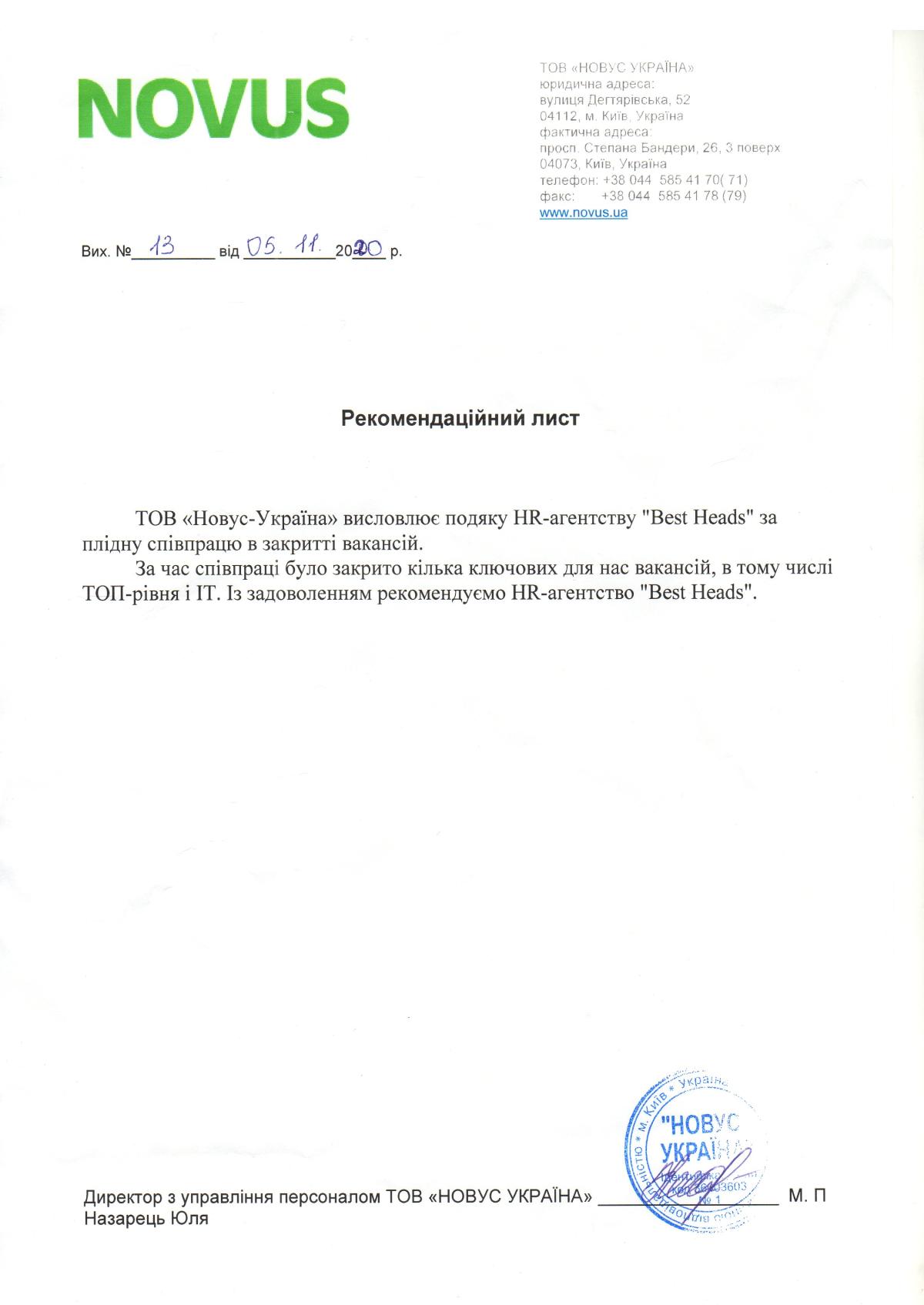
Novus-Ukraine LLC thanks Best Heads HR agency for our productive partnership in filling roles.
Over our time working together, we've closed several key positions, including top-level and IT roles. We're happy to recommend Best Heads HR agency.
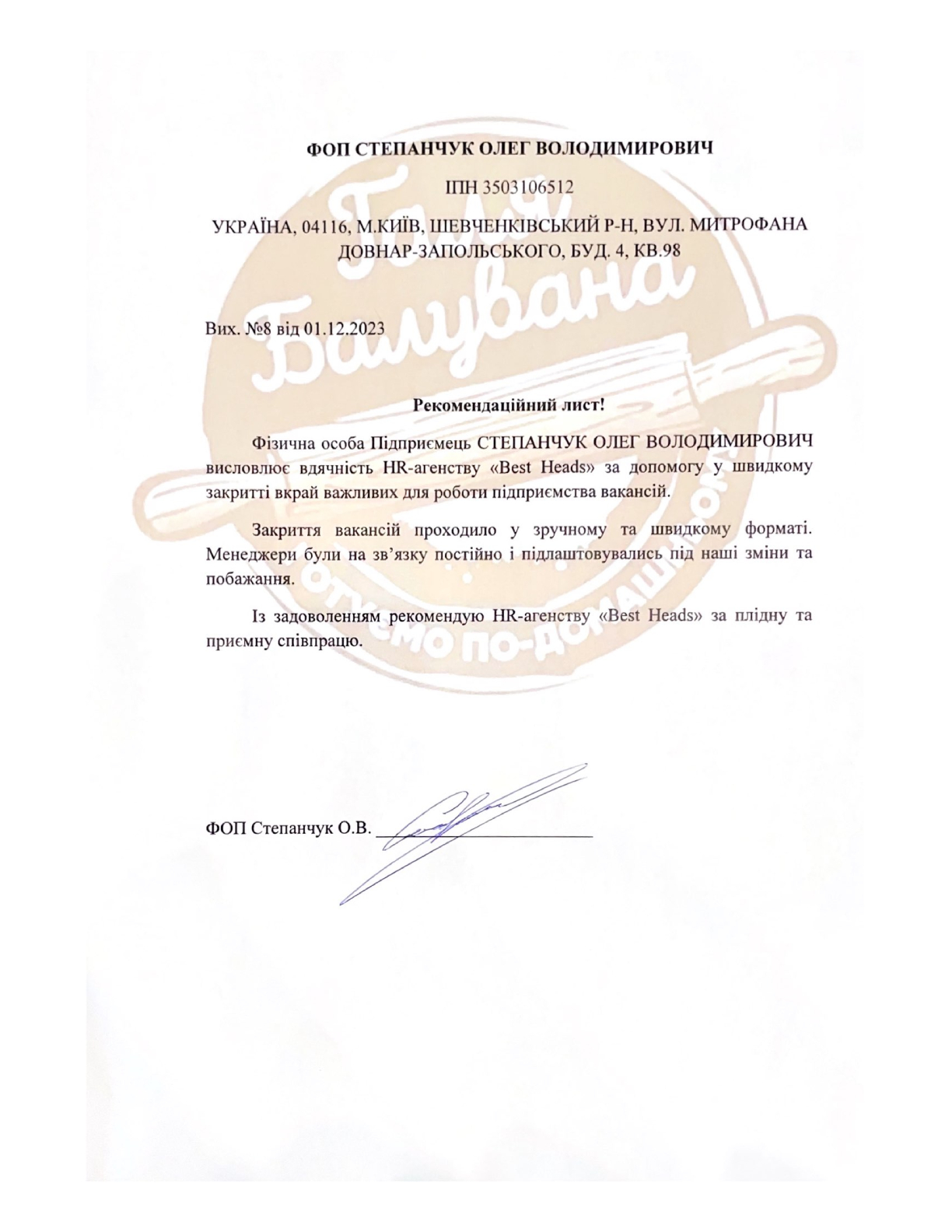
Sole proprietor Oleh Stepanchuk (Galya Baluvana brand) thanks Best Heads HR agency for helping us quickly fill roles that were critical to our operations.
The hiring process was smooth and fast. The team stayed in constant contact and adapted to our changes and feedback throughout.
We're happy to recommend Best Heads HR agency for a productive and enjoyable partnership.
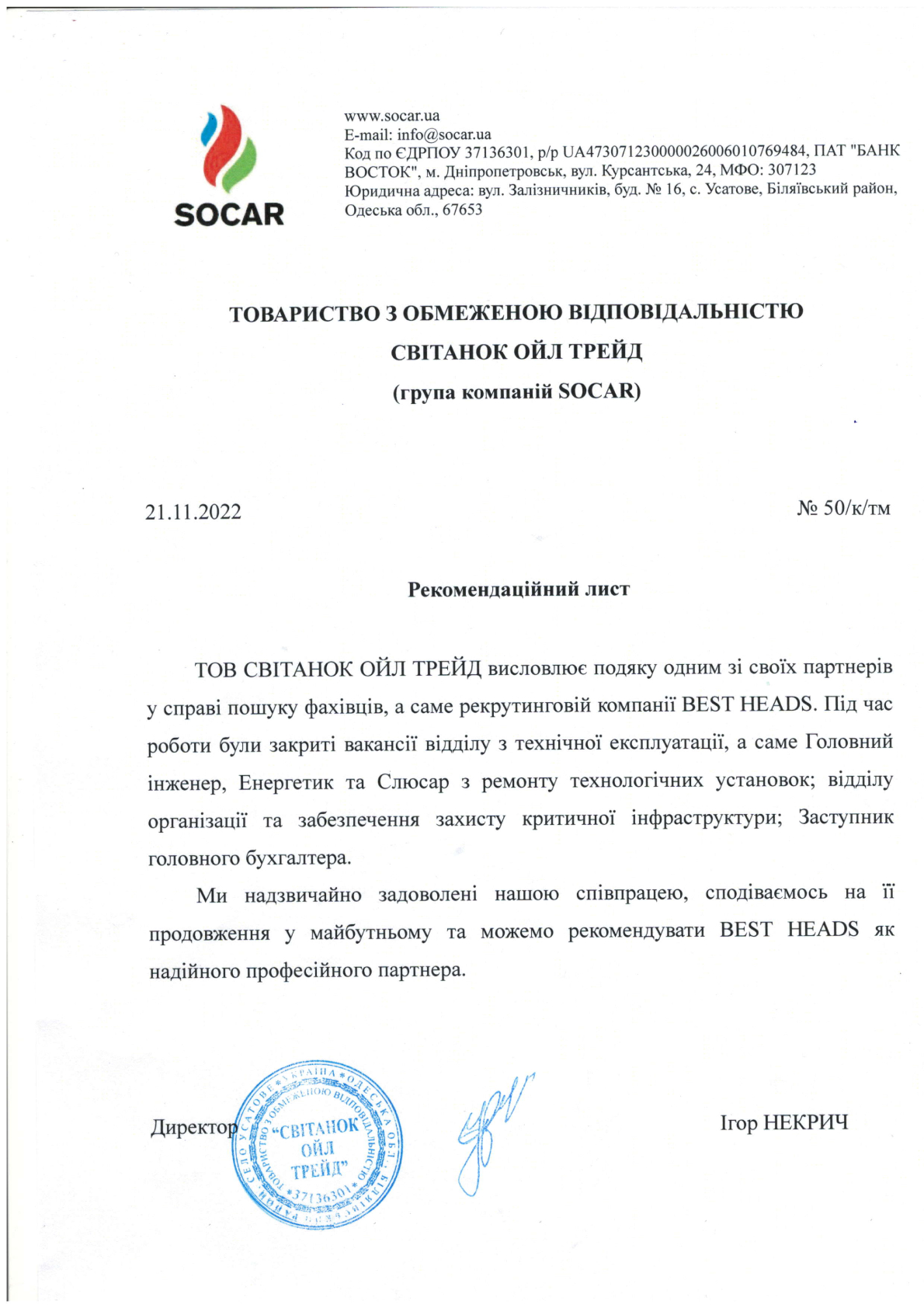
Svitanok Oil Trade LLC thanks one of our partners in talent acquisition — Best Heads recruitment agency. Over the course of our work together, they filled roles in our technical operations department — specifically Chief Engineer, Energy Engineer, and Industrial Equipment Repair Technician; in our critical infrastructure protection department; and Deputy Chief Accountant.
We're extremely happy with our partnership, look forward to continuing it, and can recommend Best Heads as a reliable and professional partner.
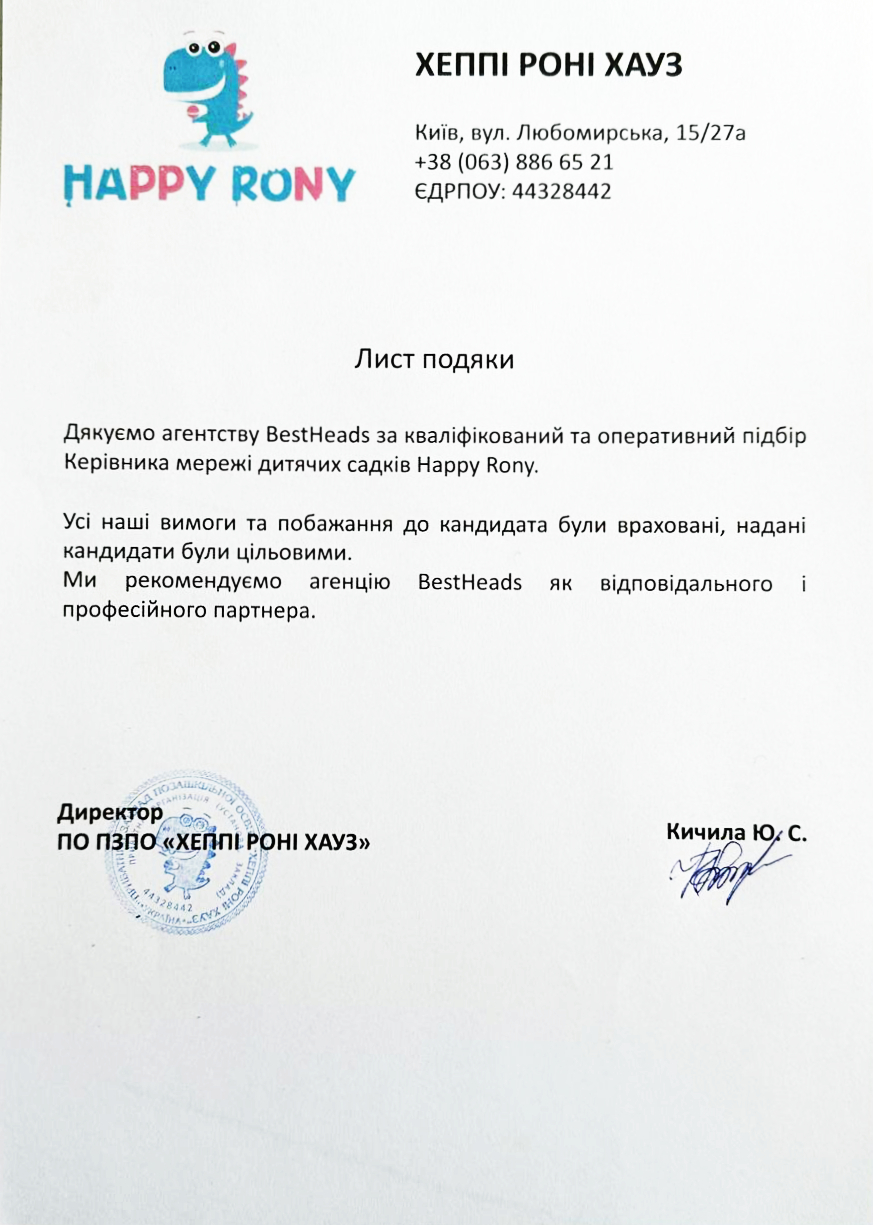
Thanks to BestHeads agency for the qualified and prompt placement of a Director for the Happy Rony chain of children's preschools.
All our requirements and preferences for the candidate were taken into account, and the candidates presented were a strong fit for the role.
We recommend BestHeads agency as a responsible and professional partner.
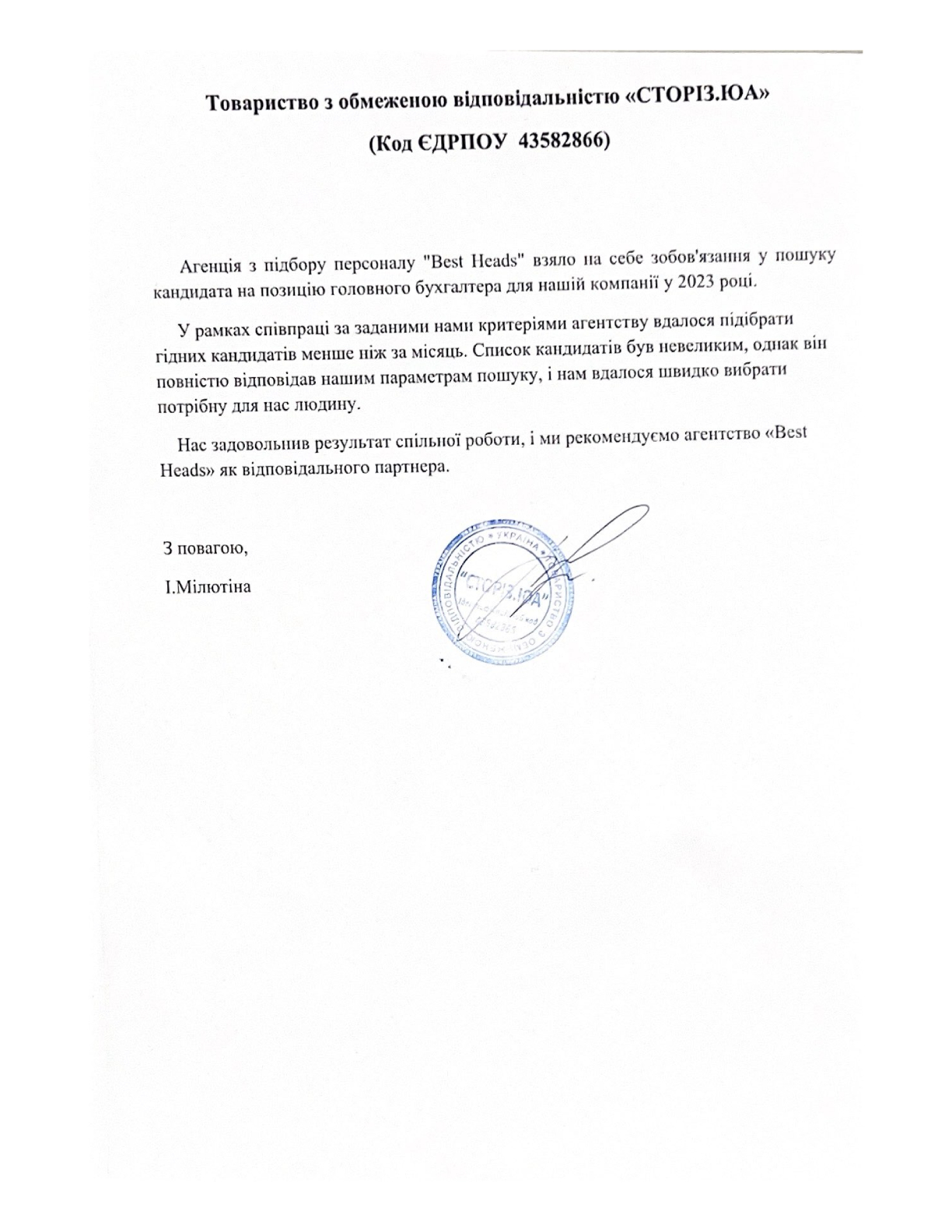
Best Heads recruitment agency took on the search for a Chief Accountant for our company in 2023.
Working from the criteria we set, the agency found strong candidates in under a month. The shortlist was compact, but it fully matched our search parameters, and we were able to quickly pick the right person for us.
We're happy with the outcome of our work together and recommend Best Heads agency as a reliable partner.
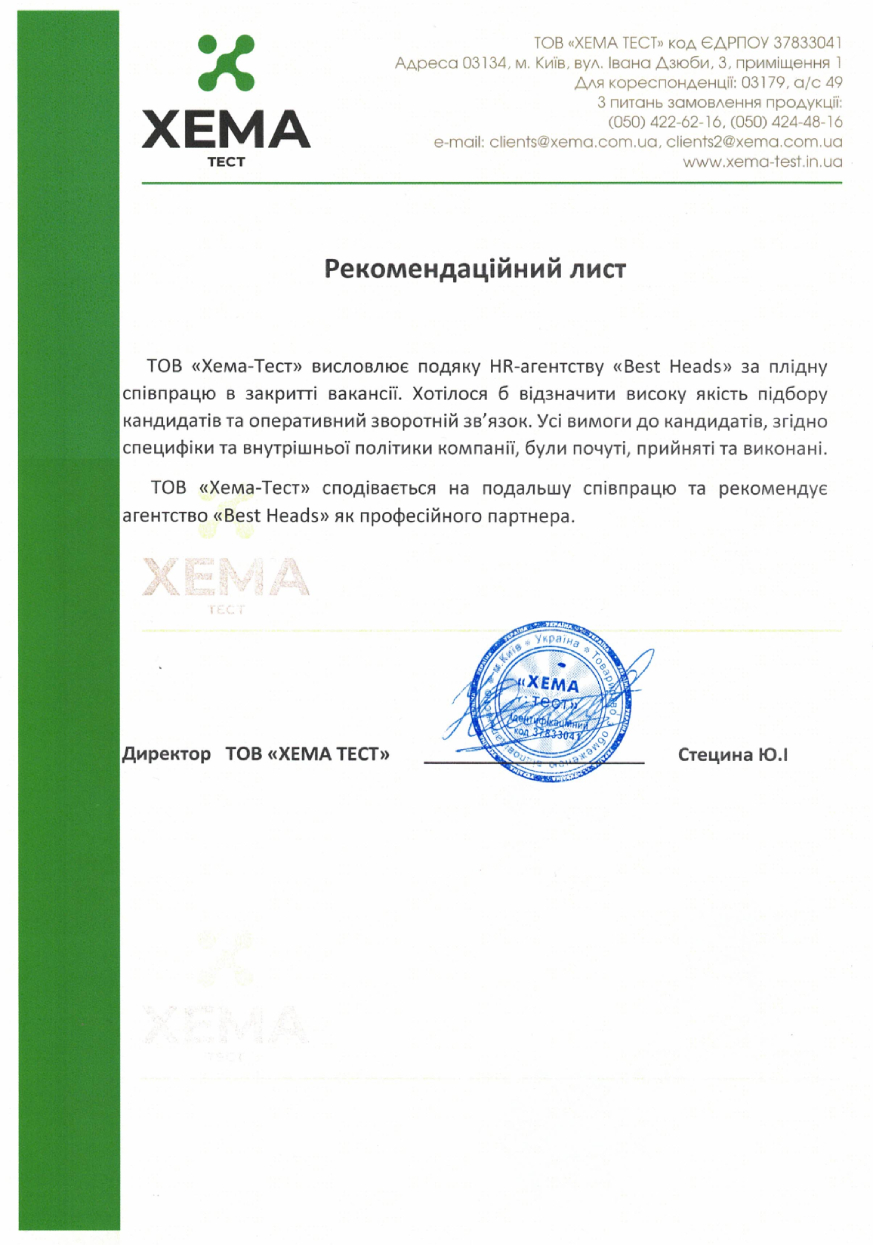
Khema-Test LLC thanks Best Heads HR agency for our productive partnership in filling roles. We'd like to call out the high quality of candidate sourcing and the responsive communication. All our requirements for candidates, including those specific to our company's policies and operations, were heard, understood, and delivered on.
Khema-Test LLC looks forward to continuing our partnership and recommends Best Heads as a professional partner.

To the team,
We want to sincerely thank your team for our productive partnership and the successful close of our top-priority role — Chief Accountant.
We deeply value your professionalism, your deep understanding of our needs, your responsiveness, and your clear communication at every stage of the search.
The candidate you presented has already started making a positive impact, and we're confident they'll contribute significantly to Monopack's growth.
Thank you for the quality of your work, your flexible approach, and your partnership. We look forward to continuing to work together!
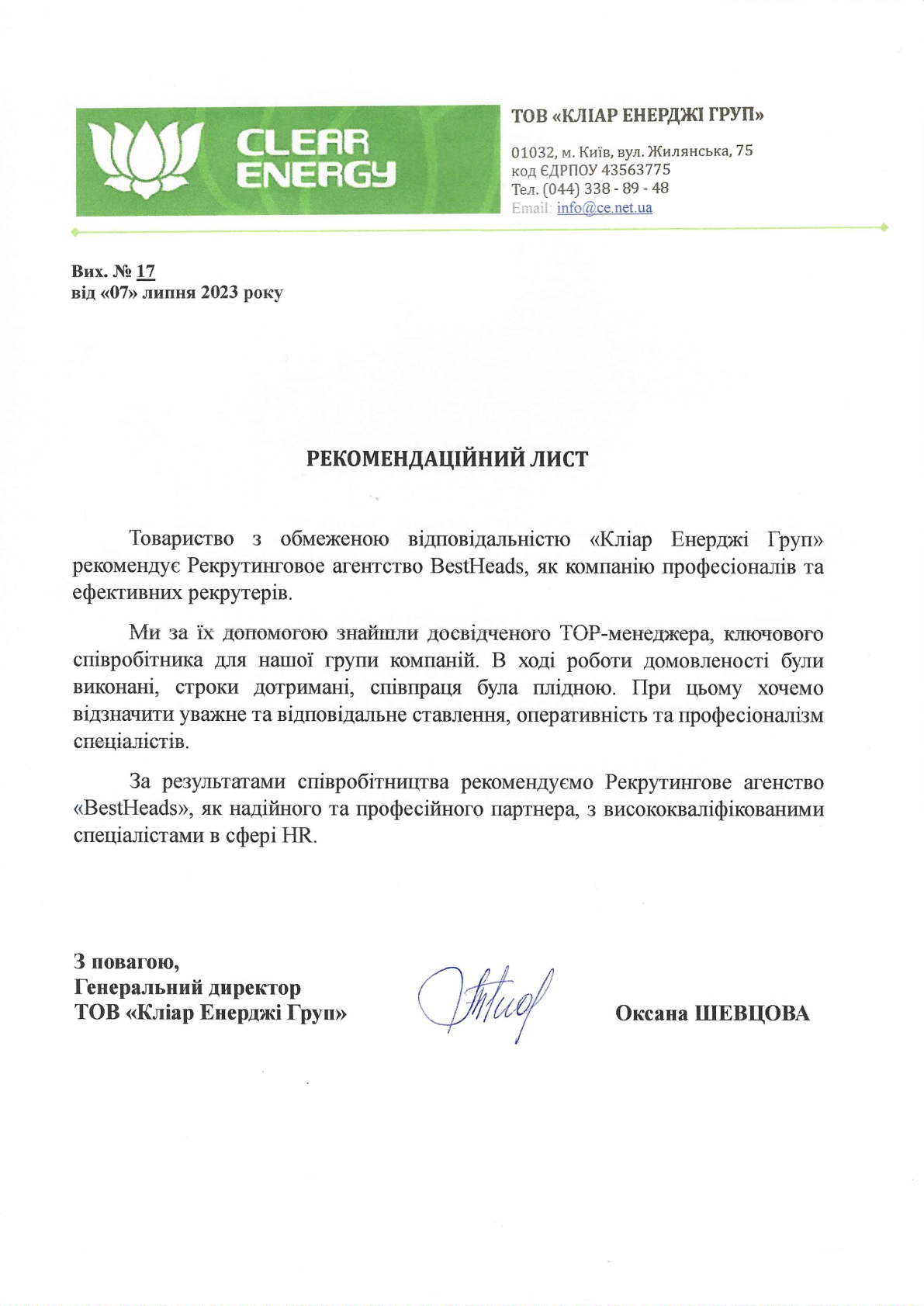
Clear Energy Group LLC recommends BestHeads recruitment agency as a team of professionals and effective recruiters.
With their help, we found an experienced top-level executive — a key hire for our group of companies. Throughout the process, commitments were met, deadlines were hit, and the partnership was productive. We'd also like to call out the attentive, responsible approach, the responsiveness, and the professionalism of their team.
Based on the outcome of our work together, we recommend BestHeads recruitment agency as a reliable and professional partner with highly qualified HR specialists.

On behalf of Solve.Care I would like to say thanks to "Best Heads" for such great cooperation. "Best Heads" helped us with two very critical positions: Technical Support Engineer and Senior Mobile (React Native) Developer. Both positions had very high demands and were on the market for more than 2 months. "Best Heads" provided us with a pool of qualified candidates and we successfully closed both positions within a month.
We have, and will continue to, recommend "Best Heads" to other companies as a very professional agency who can help you to close difficult vacancies with tough deadlines. Our team could not be more satisfied with your work, and we look forward to continuing this relationship.

On behalf of STEMAX, I want to thank Best Heads HR agency for our quality partnership on talent sourcing and placement.
The agency provided thorough consultation on the profile of the role we were hiring for, ran a salary market analysis for candidates, and shared it with us.
The candidates presented were a strong match for the role profile.
In 2018–2019, with our partners' help, we closed the CHRO and Head of Project Sales roles.
I recommend Best Heads HR agency as a reliable partner for talent sourcing and placement.
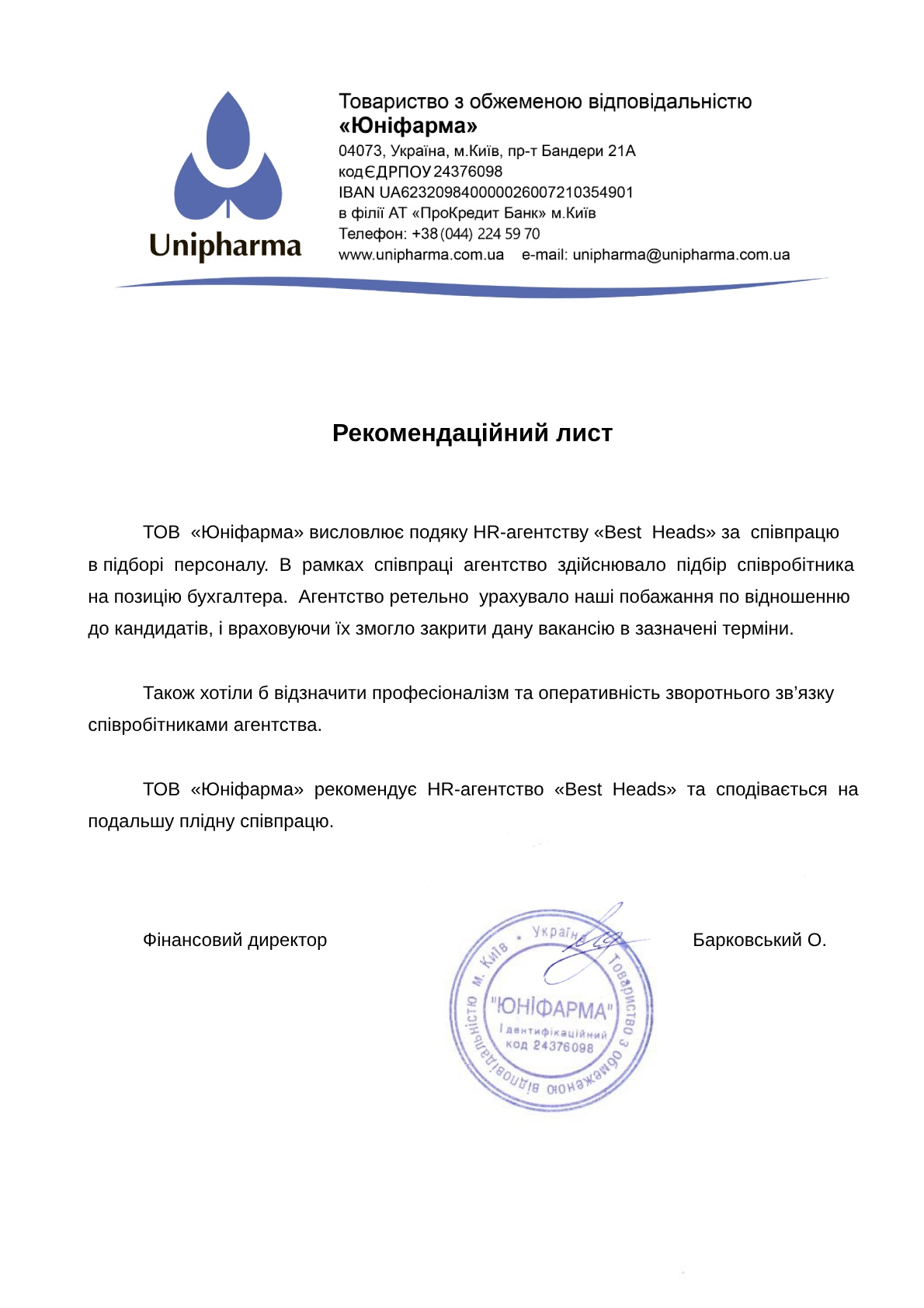
Unipharma LLC thanks Best Heads HR agency for our partnership on talent acquisition. As part of our work together, the agency ran a search for an Accountant role. The agency carefully accounted for all our preferences regarding candidates, and based on those, was able to close this role within the agreed timeline.
We'd also like to call out the professionalism and responsive communication from the agency's team.
Unipharma LLC recommends Best Heads HR agency and looks forward to continuing our productive partnership.
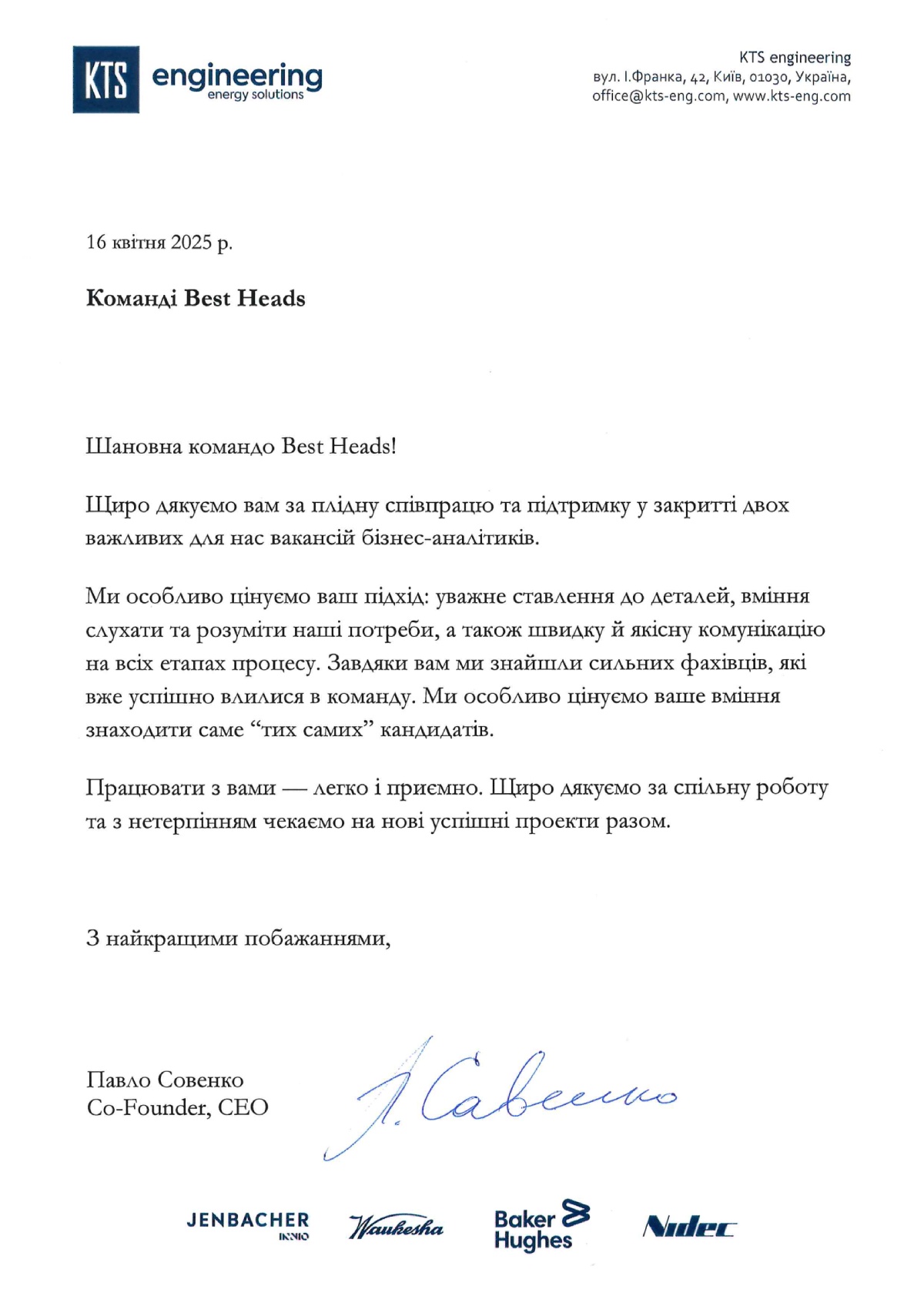
To the Best Heads team,
Thank you for our productive partnership and your support in closing two business analyst roles that were important for us.
We especially appreciate your approach: attention to detail, the ability to listen and understand what we need, and the fast, high-quality communication at every stage of the process. Thanks to you, we found strong specialists who have already successfully joined the team. We particularly appreciate your ability to find exactly the right candidates.
Working with you is easy and enjoyable. Thank you for working with us, and we look forward to more successful projects together.

On behalf of Imperia Holding LLC, we thank Best Heads HR agency for our partnership. They successfully closed what was a fairly challenging hire for our business — Head of Logistics. Over the course of the project, the agency ran a market analysis, presented us with 5 truly strong, quality candidates for the Head of Logistics role, and we picked the right fit.
We recommend Best Heads agency as a highly professional and reliable partner who will find the best candidates for executive roles, taking into account the specifics and requirements of your business.
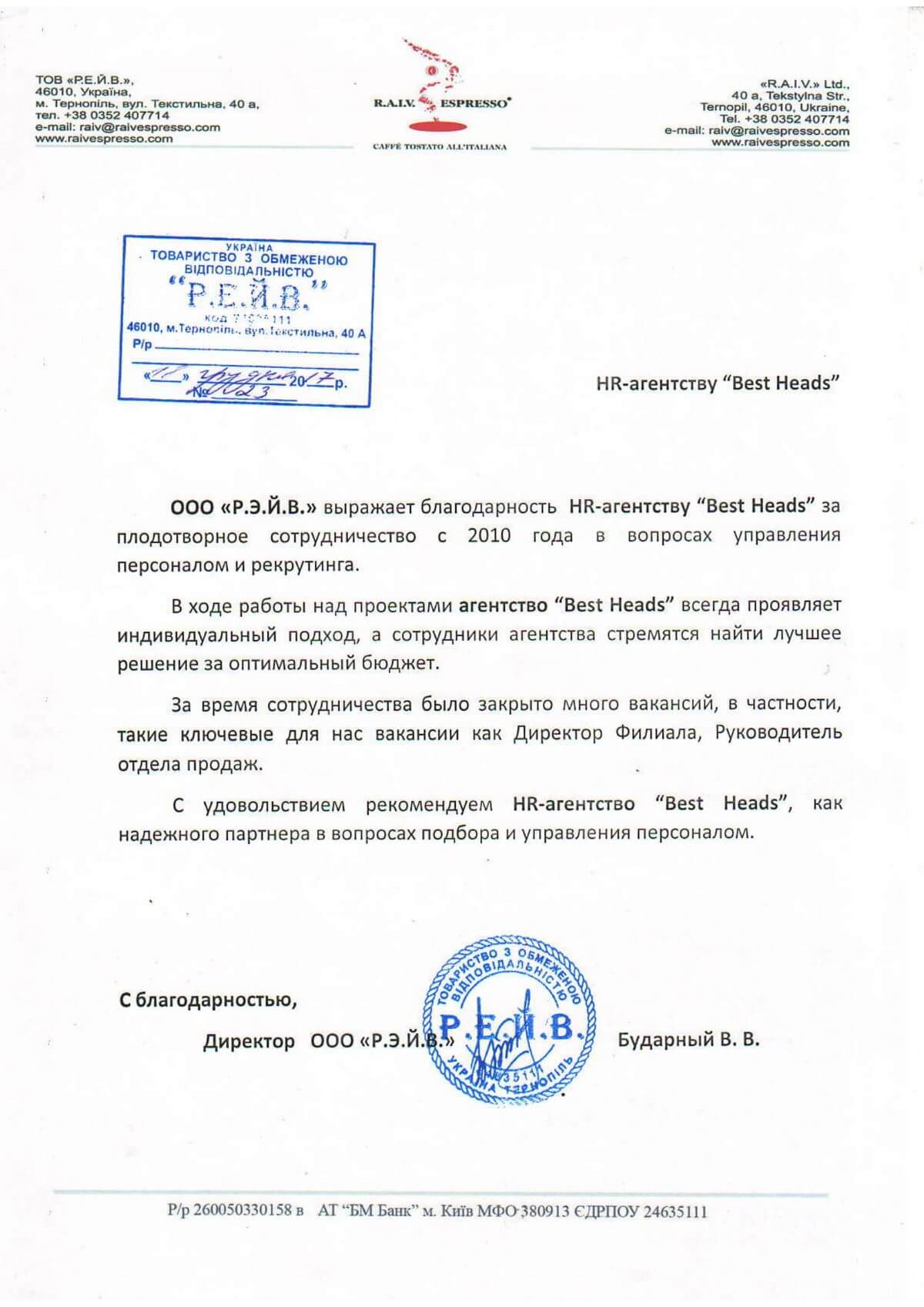
R.A.I.V. LLC thanks Best Heads HR agency for our productive partnership since 2010 on talent management and recruiting.
Throughout our work together, the Best Heads team has always taken an individualized approach, and their specialists work to find the best solution within the available budget.
Over time, we've closed many roles, including key positions like Branch Director and Head of Sales.
We're happy to recommend Best Heads HR agency as a reliable partner for talent acquisition and management.
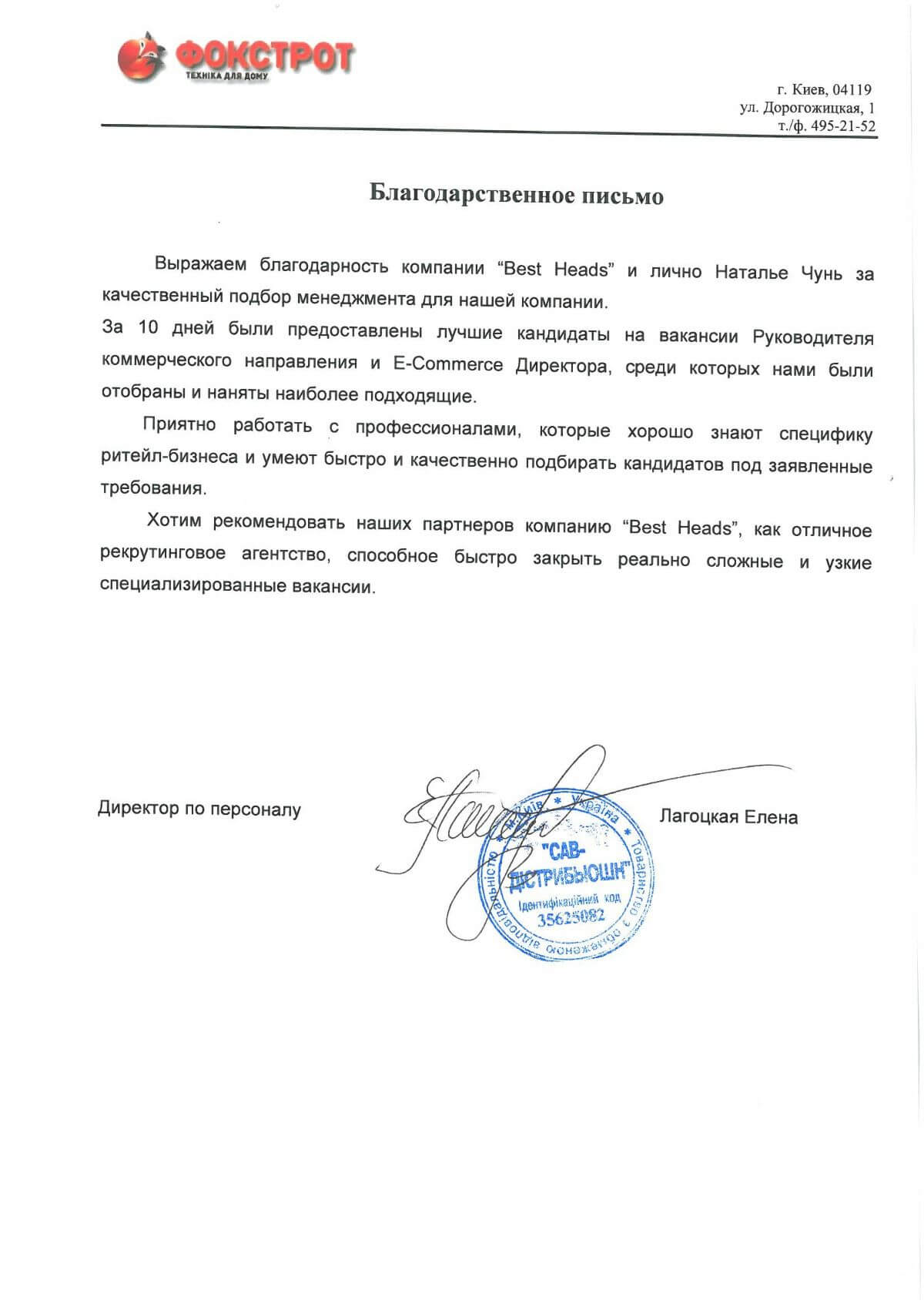
We thank Best Heads, and Natalia Chun personally, for the quality of the management-level recruiting for our company.
In 10 days, you presented the best candidates for the Head of Commercial and E-Commerce Director roles, and we picked and hired the strongest fits.
It's a pleasure to work with professionals who understand the specifics of the retail business and know how to source candidates quickly and accurately to the brief.
We're happy to recommend our partners at Best Heads as an excellent recruitment agency capable of quickly closing complex and highly specialized roles.
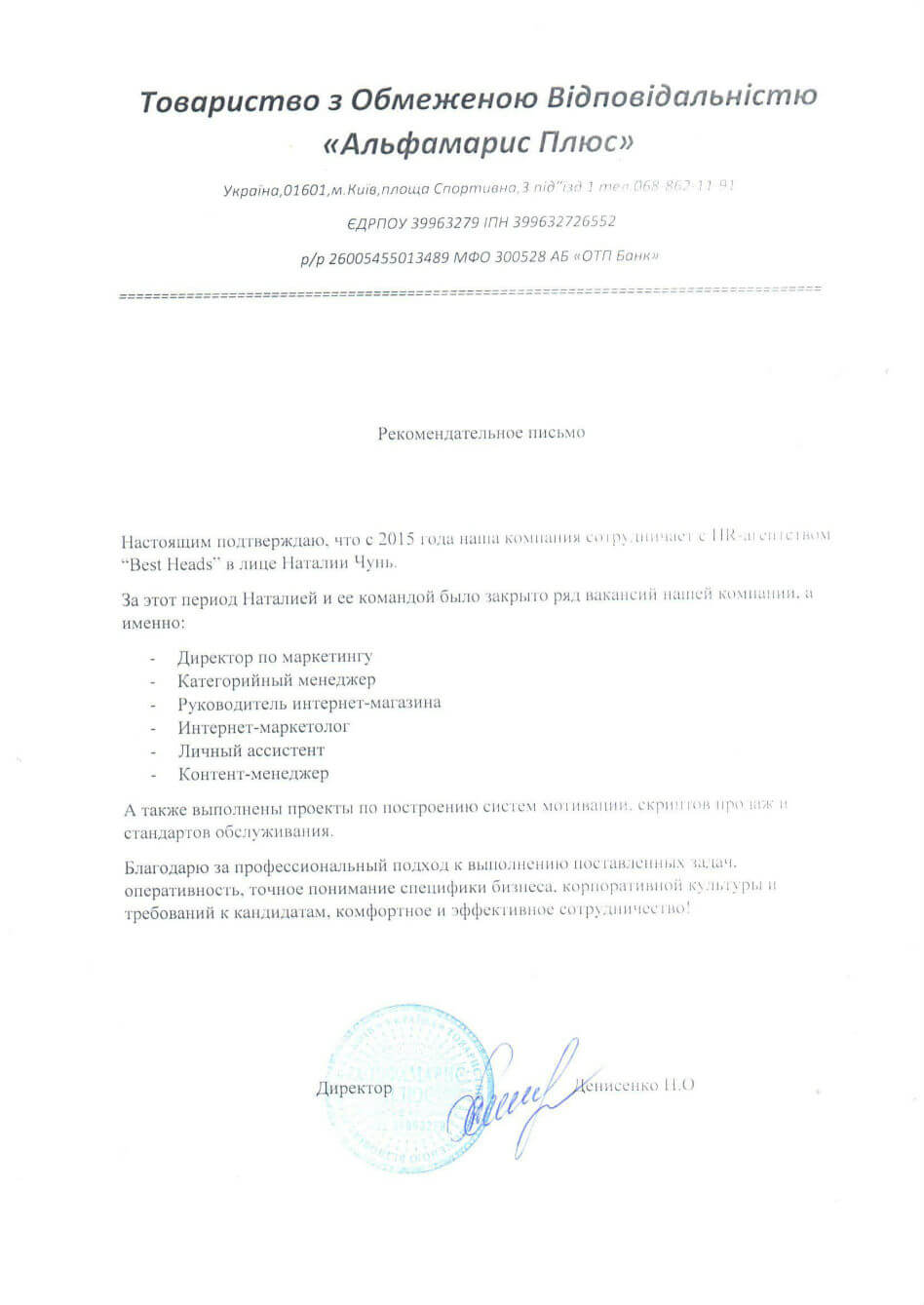
This confirms that our company has partnered with Best Heads HR agency since 2015.
Over this time, the agency has closed a number of roles for our company, including:
CMO
Category Manager
Head of E-commerce
Digital Marketing Manager
Executive Assistant
Content Manager
The agency also delivered projects on building incentive systems, sales scripts, and customer service standards.
Thank you for the professional approach, responsiveness, accurate understanding of business specifics, corporate culture, and candidate requirements, and for our smooth, effective partnership!
Industries we specialize in


Channels such as Djinni and LinkedIn have limited reach for AI roles: strong AI engineers either do not publish resumes or move straight to international contracts. We use a different approach: market mapping, domain filtering of candidates by real production experience, and direct headhunting through closed AI communities.
How we run an AI search
Ukrainian AI market data:
A Ukrainian startup will not win on rate, but it can win on product, equity and influence over technical strategy. A recruiter who cannot sell that will never get these candidates to engage.
As an AI recruitment agency we work on a success fee basis: you pay once the candidate starts.
90-day free replacement guarantee.
Book an intro call and we will work out whether the role can realistically be closed in 4-10 weeks and what the candidate pool should look like.
About Us


Frequently Asked Questions
Since 2024 this has been the most frequent request from AI startups. We screen candidates for production experience with LLMs (GPT, Claude, Llama), an understanding of RAG architectures, work with vector databases (Qdrant, Pinecone, pgvector, Weaviate) and with LangChain or LlamaIndex.
In 2026 the focus has shifted. Beyond “worked with LLMs”, we check:
A candidate who pulls CrewAI into a task that needs three prompt calls is a red flag, not a plus.
Yes, but it is a separate kind of search. AI specialists with 5+ years of experience mostly have remote alternatives at international companies paying $6,000-10,000 per month. If you need an onsite format, we tell you upfront that the pool is narrower and we adjust the sourcing process, putting the emphasis on the product, equity and the technical ambition of the role.
It depends on the domain requirement and the location. For an AI startup in Ukraine with a remote format – 4-10 weeks.
For an onsite role in Kyiv – 8-12 weeks.
For a specific niche (for example ML for medtech or AI for defense) – 2-4 months.
Our fee for a Senior ML Engineer is 1-1.5 of the candidate’s monthly salary.
For Lead, Architect, Head of AI and CDO level roles it is 12-15% of annual compensation.
Payment is due after the candidate starts, with a 90-day free replacement guarantee.
These are the standard terms we work on as an AI recruitment agency, and we are flexible and open to discussing them.
We cover both formats. For international clients in the US, UK and EU we have experience working with remote teams and an understanding of how to present local candidates to an international client: culturally, by English level and by expectations.
For Ukrainian startups it is a standard process with the emphasis on product fit and equity as one of the arguments.
Mostly product roles: ML Engineer, Data Scientist in product teams, MLOps, data engineer recruitment and MLOps recruitment. Research Scientist is a separate niche with a very narrow pool, mostly academic candidates with a PhD.
We take on these searches, but the time to close is longer and the terms are discussed separately during the intake call.
A Data Scientist explores data and builds models, which is more about research and analytics. An ML Engineer takes a finished model and deploys it to production, optimizes it for load and integrates it into the product. In startups these roles are often combined in one person, in enterprises they are separate positions with different salary ranges. ML engineer recruitment and data scientist recruitment run through different processes and different sourcing channels for us.


