
Контент
In Ukraine, unmanned systems get built, flown, and rebuilt on a weekly cycle under combat pressure. Engineers here have not studied GPS-denied navigation; they have shipped firmware that held up while the link was actively jammed. That is why US and EU defense-tech teams keep sourcing here.
Hiring into that market is harder than it looks from the outside. The strongest UAV engineers are not on Djinni or LinkedIn. Some cannot publicly name their current employer. Several roles come with a hard requirement to be physically present within a specific radius. And the compliance questions arrive before you have seen a single CV.
This guide covers which role the brief should target, what the talent pool looks like, how to screen for flight experience instead of the right keywords, what it costs, how long it takes, and how to structure the engagement legally. If you would rather hand the search to a team that already works these channels, that is what our MilTech recruitment in Ukraine practice does.
The most expensive hiring mistake in this field happens before sourcing starts. A company writes “we need a drone engineer,” interviews eight people, and rejects all eight. The problem is the brief: “drone engineer” covers six roles with barely overlapping skills, so the search was never aimed at anyone in particular.
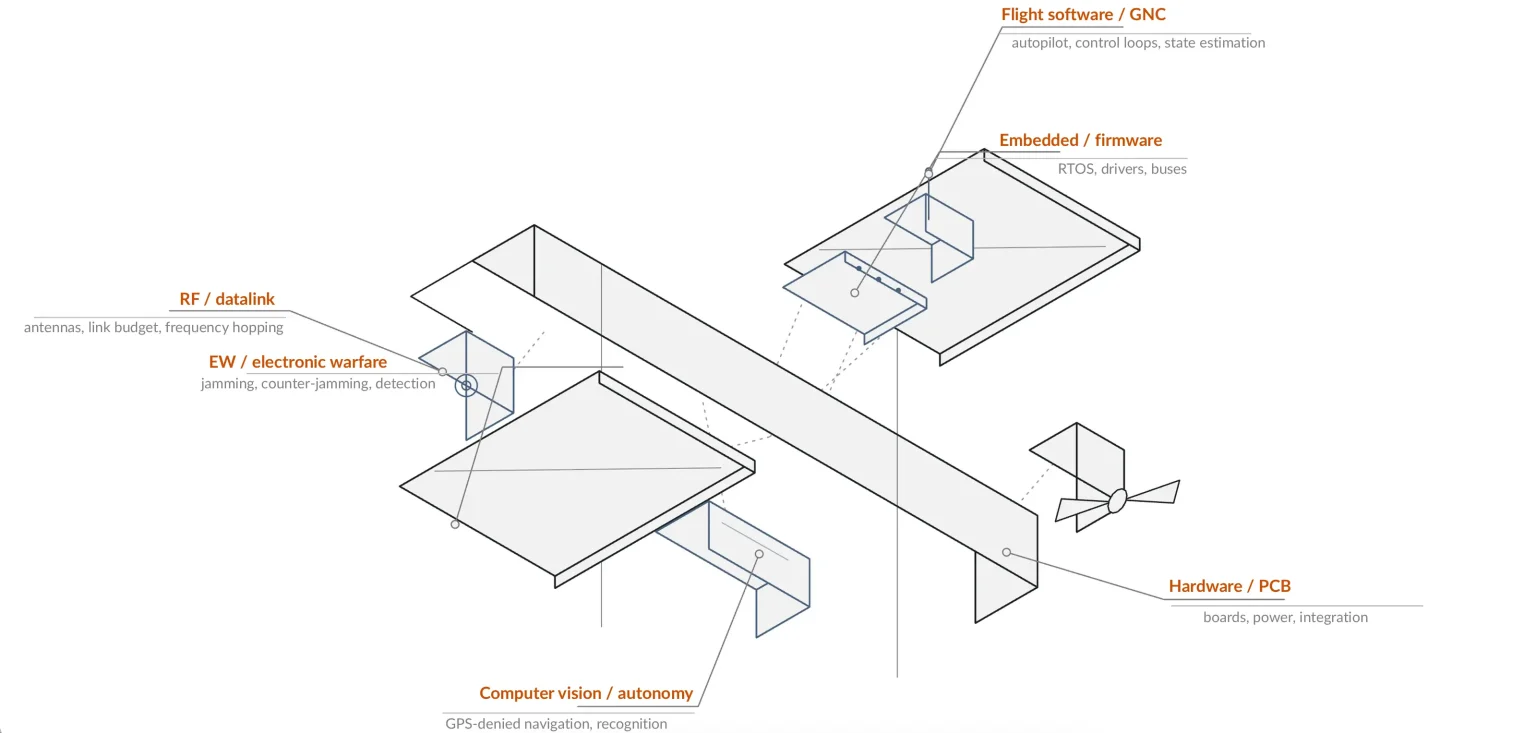
Flight software / GNC engineer. Owns the autopilot: control loops, state estimation, guidance and navigation. Works inside PX4 or ArduPilot, sometimes in a proprietary stack, and usually owns the ground control station software that goes with it. The work is applied mathematics (control theory, quaternions, filtering) expressed in C++, which makes it a poor lateral move from web or application development.
Embedded / firmware engineer. Owns everything between the silicon and the flight stack: RTOS or bare-metal firmware, peripheral drivers, communication over UART, SPI, I2C, CAN and DroneCAN, bootloaders and field updates. Measures success in microseconds and milliamps. This profile is shared with non-defense industries, which makes it the easiest to source and the easiest to get wrong.
RF / datalink engineer. Owns the radio link: transceivers, antenna design and placement, link budget, frequency hopping, mesh topologies, resilience under interference. Consistently the scarcest profile on the market. The reason is structural. The discipline needs a physics and radio-engineering education that far fewer people have, and learning it depends on equipment and slow feedback.
EW engineer (electronic warfare). Owns detection, jamming and counter-jamming. Related to RF but a separate world, with backgrounds usually in radio-physics or military engineering rather than commercial IT. If you are building counter-UAS or a jam-resistant platform, treat this as its own search with its own candidate pool.
Computer vision / autonomy engineer. Owns navigation when GPS is unavailable, target recognition, and on-board inference. Works with visual odometry, optical flow, SLAM, sensor fusion, and edge deployment on NVIDIA Jetson with TensorRT. Watch for the difference between someone who trains models and someone who has made a model run in real time on a power-constrained board that vibrates.
Hardware / PCB engineer. Owns the physical product: schematics, board layout, power distribution, thermal behaviour, EMI, payload integration. Often the bottleneck nobody budgets for, because software candidates are easier to find and teams postpone the hardware hire until integration fails.
A practical way to write the brief is to describe the outcome instead of the job title. “We need someone who can take our fixed-wing platform from a working prototype to three hundred units with a stable datalink at 30 km” tells a recruiter which of the six profiles to search for. A title does not.
| Role | Owns | Core stack | Typical background |
|---|---|---|---|
| Flight software / GNC | Autopilot, control, navigation, GCS software | PX4, ArduPilot, C++, EKF | Control systems, aerospace |
| Embedded / firmware | Firmware, drivers, buses | C/C++, Rust, FreeRTOS, Zephyr, STM32 | Embedded product IT, electronics |
| RF / datalink | Radio link, antennas, resilience | SDR, GNU Radio, FHSS, link budget | Radio engineering, physics |
| EW | Jamming, counter-jamming, detection | SDR, signal analysis, RF hardware | Radio-physics, military engineering |
| CV / autonomy | GPS-denied navigation, recognition | ROS2, OpenCV, SLAM, Jetson, TensorRT | ML and robotics with real-time focus |
| Hardware / PCB | Boards, power, integration | Altium, KiCad, EMI, thermal | Electronics engineering |
Where these engineers came from explains both their strengths and their gaps.
The pool did not come out of universities. It formed from three converging streams:
Around them sits an ecosystem: the Brave1 defense-tech cluster, several hundred UAV manufacturers, and R&D teams attached to production facilities. Engineering density is highest in Kyiv, Lviv, Kharkiv and Dnipro.
Teams here iterate fast. They are used to a cycle where a change is designed, flown and evaluated within days, with feedback coming from operational use rather than a lab, and they are comfortable with imperfect hardware and thin documentation. Almost no Western engineer has had their product jammed, spoofed and intercepted in the field and then had to engineer the counter. Ukrainian teams have, repeatedly.
Formal certification experience is thinner here. If your product needs DO-178C, AS9100 or a comparable regime, expect to build that process on your side. You will find engineers who can meet the requirements, but far fewer who have run the paperwork before. Documentation culture is weaker than in a mature Western engineering organisation, since the same speed that produces fast iteration also produces sparse design docs.
In practice, Ukrainian engineers are strong precisely where most startups struggle: turning a prototype into a reliable, manufacturable product fast. Certification and high-volume scale-up usually stay your responsibility.
Companies usually contact us after they have already tried. The pattern is consistent. They posted on the standard platforms, received either nothing or a stack of irrelevant CVs, and concluded that the talent does not exist. It does. It is simply not reachable that way, for the specific reasons.
The strong candidates are not looking. Djinni, DOU and LinkedIn are built around active job seekers in commercial IT. A senior firmware engineer at a drone manufacturer that is shipping units is not browsing vacancies. Reaching them takes a direct approach with a reason worth their attention.
Their profiles are deliberately incomplete. This surprises foreign clients most. Under their current agreements, many engineers cannot publicly disclose their employer or describe their project. Their LinkedIn shows a two-year-old job at a commercial company and no recent activity. Judged on the profile alone, they look weak. They are often the strongest person available.
The market is relationship-based. Hiring happens through closed professional communities, referrals inside the industry, direct approaches to specific manufacturers, and engineering meetups. Time-to-hire in defense tech is set by the quality of an existing network rather than by advertising budget. A search that produced nothing in three months can close in under three weeks once it runs through the right channels.
The core error is screening against a technology list. “PX4, ROS2, C++, MAVLink” appears on the CV of everyone who has read the documentation and on the CV of everyone who has shipped a hundred aircraft. The words are identical. You have to ask questions the second group can answer and the first cannot.
Five question groups do most of the work.
Ask: How many airframes have you personally flown with your code on board? What was your worst crash, and what caused it?
A strong answer is specific and slightly uncomfortable. It names a number, describes a failure (a desync between IMU and estimator, a brownout under load, a control loop that oscillated at a particular airspeed) and explains how they found it. The best candidates volunteer failures without being pushed, because in this discipline failures are the primary teacher.
A weak answer stays abstract: “we tested extensively,” “everything worked in simulation.” Simulation-only experience is not disqualifying for a junior. For a senior it is a serious signal.
Follow up with: walk me through how you analyse a flight log after an incident. Someone who has done it will go straight to specific log parameters and how they correlate signals. Someone who has not will speak in generalities.
Ask: Your firmware works on the bench and fails in the air. Walk me through your debugging process.
This question separates software engineers from embedded engineers. The answer you want involves physical instruments (oscilloscope, logic analyzer) and reasoning about vibration, temperature, power draw and EMI. A candidate whose experience is purely software will reach for logging and unit tests, which is exactly what does not help when the cause is a voltage sag during motor spin-up.
Do not ask “do you know PX4.” Ask: What did you modify in PX4: parameters, a module, or the core?
The three answers describe three different engineers:
The same pattern applies elsewhere. Not “have you used ROS2,” but “what did you have to change because the default DDS behaviour did not work for you.” Not “do you know SDR,” but “describe a link budget you calculated and what you changed after measuring.”
Ask: How many units shipped with your code or your board in them?
This separates a researcher from a product engineer. Both are valuable, but they are not interchangeable. Someone who has taken a design through a few hundred units has dealt with component substitution, unit-to-unit variance, field updates, and failures they could not reproduce on their desk. Someone with an impressive prototype has not.
Ask: How have you handled navigation when GPS was denied? What did you do about interference on the datalink?
These constraints define the domain, and answers here are hard to fake. Expect concrete techniques (visual odometry, optical flow, inertial dead reckoning, terrain matching, frequency hopping, moving to a different band, antenna repositioning) described with their trade-offs and limits. Vague answers usually mean the candidate has read about it.
One practical note. Thirty minutes with a practising engineer filters better than a week of recruiter screening. If nobody in-house can run that conversation, get access to someone who can. Every domain interview in our own process is run by a practitioner from our network, because CV volume is not a proxy for verified experience.
Read the stack in layers. Each layer tells you something different about what the person does.
Autopilot layer. PX4 and ArduPilot dominate, Betaflight appears in FPV work, and NuttX underlies PX4. MAVLink is the near-universal protocol, with QGroundControl and Mission Planner on the ground side. Seeing these means the candidate operates at flight-stack level, though the range within that line is enormous, which is what the depth question above is for.
Low level. C and C++ remain the foundation, and Rust is appearing steadily in new firmware. FreeRTOS and Zephyr are the common RTOS choices alongside bare-metal work. ARM Cortex-M and STM32 are the standard targets. Bus experience across UART, SPI, I2C, CAN and DroneCAN indicates integration work rather than application-level coding.
Autonomy and vision. ROS2 for robotics middleware, OpenCV for classical vision, SLAM and visual odometry for positioning without GPS, EKF and Kalman filtering for state estimation. On the deployment side, NVIDIA Jetson with TensorRT is the common target. A model that performs well in training still has to be quantised and cut down to fit a latency budget on the board, and a CV that shows only training work does not tell you whether the candidate has done that.
Communications and EW. SDR and GNU Radio, frequency hopping, mesh networking, link budget analysis, anti-jamming techniques. This layer is where the scarcity is, and where depth is hardest for a non-specialist to assess.
Testing maturity. SITL, HIL and Gazebo in a CV are a strong positive signal. They point to an engineer who has worked in a team with a verification process rather than testing by flying and hoping.
Combination across layers beats depth in one. An engineer who covers both the autopilot and the hardware it runs on is worth more than two narrow specialists, because they close the integration gap where most schedule slippage happens.
This is where Ukrainian engineers tend to have an edge. Teams here are small and move fast, so people routinely end up owning more than one layer: the firmware engineer who also tunes the autopilot, the RF specialist who lays out their own board, the CV engineer who wires the payload they are writing code for. Breadth like that rarely shows up on a CV organised by job title, so ask directly which layers the candidate has owned end to end.
For US and EU clients this is usually the blocking question.
NDA before the briefing is normal here. In Ukrainian defense tech, a company will not describe the product, the stack or the location before an agreement is signed, and neither will a serious recruiting partner. Treat it as a sign of a competent counterparty.
Clearance and background checks apply to some roles, not all. Positions that touch state secrets require formal clearance and a background check, which adds time. A large share of dual-use and commercial-platform work does not. Establish this at the briefing stage, since clarifying it late means weeks spent on candidates who cannot legally take the role.
Export control is the item most often underestimated. ITAR and EAR regulate not only physical hardware but the transfer of technical data to a foreign person, and under ITAR that transfer can occur simply by granting access to controlled technical data, including inside your own systems. If your product or its components fall under ITAR, engaging a non-US engineer requires legal analysis before the hire, not after. The same logic applies to EU dual-use regulations.
This section describes common practice and is not legal advice. Export-control determinations depend on your specific product, jurisdiction and end use, and this is one of the few areas in hiring where a mistake is expensive. Involve a specialist export-control attorney before you make an offer.
IP assignment must be explicit. Rights do not transfer automatically. Your contract needs a clear IP assignment clause covering work product, drafted to be enforceable in the jurisdiction you intend to use.
OPSEC is a practical matter. Separate repositories, scoped access, no public references to the project, and a clear policy on what can be discussed externally. Reasonable engineers in this field expect these constraints.
Expectations here are the most common source of a failed search.
Remote works for some roles. Flight software, computer vision, autonomy and the ground-station side can be done remotely with a well-organised team.
Embedded sits in between. Firmware work is possible remotely once the engineer has a bench and the target hardware at hand, but early integration, bring-up of a new board and anything involving the airframe pull them on-site. Most embedded arrangements end up hybrid.
Hardware, EW and integration are on-site. They need physical access to benches, anechoic chambers, aircraft and test ranges. That is a physical constraint, not a workflow problem. RF sits close to the same line: link testing needs antennas and range access, so remote RF work is rare.
Some roles carry a city-radius requirement. Certain positions require the engineer to live within a defined distance of a facility or test site. Filter this at the start of the search, or a candidate who is perfect on every technical dimension and lives in the wrong city will drop out at the final stage.
Relocation abroad is generally not available. Under martial law, exit restrictions apply to most men of working age, so a plan built on moving an engineer to your US or EU office will usually not work. The workable models are remote engagement from Ukraine or your own R&D presence here. One exception is worth knowing: Ukrainian engineers already abroad and open to relocating to you are a smaller but active channel.
Ask about reservation status. Employees of critical enterprises can be granted deferment from mobilisation. Whether a company can provide this affects team stability, and it is a fair question to raise early.
| Role | Remote viable? |
|---|---|
| Flight software / GNC | Yes |
| CV / autonomy | Yes |
| Embedded / firmware | Partially, needs hardware access |
| RF / datalink | Rarely |
| EW | No |
| Hardware / PCB | No |
Three models cover almost every case.
Direct B2B contract with a Ukrainian sole proprietor (FOP). The most common arrangement. Tax treatment is favourable, the structure is flexible, and it can be set up quickly. The administrative overhead sits with you.
Employer of record or a local provider. Faster and lower-risk on compliance, since the provider handles contracts, payments and local obligations. Typically adds roughly 10 to 20 percent to the cost.
Your own legal entity or R&D office. Justified from around eight to ten engineers. Higher setup and maintenance cost, but full control, easier long-term IP handling, and a stronger basis for a permanent team.
Whichever model you choose, the contract needs the same core provisions:
A detailed breakdown of each structure is covered in our separate guide on legally engaging Ukrainian engineers.
Monthly rates under a B2B contract, mid-2026 market estimates. Defense-sector rates run roughly 15 to 30 percent above equivalent commercial product roles, driven by scarcity and by on-site and confidentiality constraints.
| Role | Middle | Senior |
|---|---|---|
| Embedded / firmware | $3000 — $4500 | $4500 — $7000 |
| Flight software / GNC | $3500 — $5000 | $5000 — $7500 |
| CV / autonomy | $3500 — $5000 | $5000 — $7500 |
| RF / datalink | $4000 — $5500 | $5500 — $8000 |
| EW | $4000 — $6000 | $6000 — $9000 |
| Hardware / PCB | $3000 — $4500 | $4500 — $6500 |
These are market estimates for orientation, not quotes. Actual rates depend on clearance requirements, location constraints and the specific combination of skills.
For comparison, an engineer at a similar level in the US or Western Europe typically costs three to four times as much. Cost is the weaker argument, though. The stronger one is availability. For candidates with field-tested RF and EW experience, the Western market often has nobody available at any price, because the people with that background sit inside defense primes and are not moving.
Timelines. For a well-defined brief, embedded and flight-software searches commonly close in two to three weeks, with a first shortlist inside the first week. Harder briefs, particularly in EW, run closer to six weeks.
What extends a timeline: a clearance requirement, a city-radius constraint, and narrow skill combinations such as RF plus EW plus production experience. What compresses it: a clear brief, a decision-maker available for interviews within days rather than weeks, and realistic expectations about location.
Recruitment cost. The standard model is a success fee calculated as a percentage of annual compensation, payable on hire, with a replacement guarantee if the placement does not work out.
FAQ
Yes. Foreign companies routinely engage Ukrainian engineers through direct B2B contracts, an employer of record, or their own local entity. The constraints are practical rather than prohibitive: some roles require on-site presence, and your own jurisdiction’s export-control rules may restrict what technical data you can share.
Yes. Ukraine’s IT and defense-tech sectors operate normally and companies contract with foreign clients continuously. Martial law affects mobility, particularly exit from the country, rather than the legality of employment or contracting.
Mid-2026 market estimates run roughly $3000 to $6000 per month for mid-level engineers and $4500 to $9000 for seniors under a B2B contract, depending on specialisation. RF and EW profiles sit at the top of both ranges because of scarcity. Defense-sector rates run 15 to 30 percent above equivalent commercial roles.
Two to three weeks is realistic for a well-defined brief, with a first shortlist inside the first week. Clearance requirements, city-radius constraints and narrow skill combinations extend this, and harder electronic-warfare briefs typically run closer to six weeks.
Only for roles that involve access to state secrets. Many dual-use and commercial-platform positions do not require it. Where clearance is needed, a formal background check applies and the timeline extends, so establish this during the initial briefing.
Software roles such as flight software, computer vision, autonomy and ground-station development work well remotely. Embedded work is usually hybrid. RF is usually on-site, since link testing needs antennas and range access. Hardware, EW and integration roles need physical access to equipment and test facilities and are on-site.
Only what your contract specifies. IP does not transfer automatically, so an explicit assignment clause covering all work product is essential, drafted to be enforceable in your chosen jurisdiction. This applies equally to B2B contracts, EOR arrangements and direct employment.
“UAV engineer” is a broad term covering systems-level work across airframe, avionics and integration. “Drone software engineer” is narrower and usually means flight software, autonomy or ground-station development. Given how loosely both are used, define the role by responsibilities rather than by title.
PX4 and ArduPilot for autopilots with MAVLink for communication. C/C++ and increasingly Rust at firmware level on FreeRTOS, Zephyr or bare-metal targets, typically STM32. ROS2, OpenCV and NVIDIA Jetson for autonomy and vision. SDR and GNU Radio for communications and electronic warfare.
Generally not, since martial law restricts exit for most men of working age. The workable models are remote engagement or a local R&D presence. Ukrainian engineers already living abroad who are open to relocation are a separate and smaller channel.