
- R&D Engineers and Developers for Defense-Technology products
- Confidential search that respects project secrecy
- Candidates evaluated by a domain practitioner from our network
- First shortlist within 5 days, even for scarce profiles


Get a quote and timeline for your hire
MilTech (defense sector) recruitment differs from standard product IT in three key aspects:
We have a dedicated process for this, including a channel to hire Ukrainian software engineers based abroad who are ready to relocate.
Why recruiting for the defense sector is more complex than standard IT:
All three constraints above compress the funnel. The NDA means the role cannot be posted publicly or even named, so the reach of open boards is lost. Location and clearance requirements rule out a large share of the remote pool. And because strong embedded and RF engineers in this sector rarely sit on Djinni or DOU, the search runs almost entirely through closed channels. Fewer reachable candidates, a longer qualification step, and no public posting are exactly why these roles take longer than a standard product IT hire.
Technical requirements in the MilTech vacancies we handle most frequently: C/C++ and Rust for embedded systems, firmware for ARM Cortex-M and Cortex-A microcontrollers, DSP, real-time operating systems (FreeRTOS, Zephyr, specialized military RTOS), protocols like MAVLink, SBUS, and AUTOSAR, RF engineering, antenna systems, plus ML and Computer Vision for target recognition and GPS-denied optical navigation. In practice this spans embedded firmware and hardware / RF engineer recruitment, and we mirror these requirements in the candidate brief exactly as the client’s CTO expects them.
UAV / drone engineer hiring is one of our most frequent defense requests, from flight-controller firmware to onboard computer vision. In this segment we have closed roles such as an Electronic Warfare (EW) systems developer and an embedded developer for UAV hardware and communication systems, with the technical assessment handled by a verified expert reviewer from our own database rather than by keyword matching.
A related embedded case: Senior C/C++ Embedded developer for CHI Software (IoT, closed in 18 days) confirms our team’s ability to verify low-level expertise rather than just filtering by keywords.
The average time to fill a Senior embedded role is 3–6 weeks. For rare roles (EW, RF) – up to 8 weeks. We offer a 90-day free replacement guarantee. Clients come to us when their in-house HR and public platforms (Djinni, DOU, LinkedIn) fail to close the role, which is a typical scenario for defense companies.
Filled Roles and Timelines

We found more than an engineer – a specialist who combines deep expertise in radiophysics, circuit design, and embedded programming. The role involves designing complex Electronic Warfare (EW) systems from scratch, working with live RF hardware, and field-testing solutions. The role requires relocation and a high level of autonomy, technical depth, and systems thinking.
A defense-sector manufacturer of radioelectronic equipment. The role called for a full-cycle development engineer – from soldering SMD components and working with antenna-feeder systems to programming microcontrollers and supporting products on the production line. A narrow profile at the intersection of hardware radioelectronics and embedded development

CHI Software is an international tech company specializing in building cutting-edge solutions for web and mobile platforms. Since its founding in 2006, the company has expanded its global footprint with offices in Ukraine, Japan, Poland, Spain, the US, and Cyprus, and continues to grow with 800+ specialists.
Recruiting for the defense sector differs from standard IT recruiting: we cannot disclose all of our clients.
Here is how recruiting for the Ukrainian defense industry differs from hiring for a product IT startup.
NDA from the First Call
Vacancies in defense companies are most often confidential. The client is not prepared to discuss the role or the type of product without a signed non-disclosure agreement. We sign an NDA before the briefing and work with minimally disclosed information—neither the company name, nor the stack, nor the location is shared externally without permission.
We disclose project details to candidates only after they agree to sign an NDA. The agreement covers the company name, product type, technology stack, and work location. We coordinate the wording in the job description for the candidate with the client in advance to ensure no sensitive information is leaked through the text of the job posting.
Searching in Closed Communities
Public platforms (Djinni, DOU, LinkedIn) are ineffective in the defense sector. Strong engineers rarely post their resumes there, and some candidates, due to current employment agreements, cannot publicly indicate their current employer at all. We search through closed channels.
Some vacancies in the Ukrainian defense industry require physical presence in Ukraine and on-site work, as well as security clearance. For certain roles, a background check is conducted. We clarify these conditions during the briefing stage and filter out irrelevant candidates before the interview.
We recruit engineers for drone-related projects with the understanding that some roles have a requirement to reside within a specific city radius—this is also filtered at the start.
Understanding Technical Roles
BestHeads recruiters have managed technically complex projects in C/C++ Embedded, Rust, DSP, and RTOS—stacks where verifying low-level experience is essential. This gives us an understanding of what to look for in a resume, what questions to ask during pre-screening, and how to distinguish a candidate with real experience from one who has simply listed the “right” keywords.
In practice, this means our recruiters see the difference between ARM Cortex-M and Cortex-A, notice when a candidate confuses MAVLink with SBUS, and do not send the client CVs that are relevant only due to matching keywords. For rare roles (RF Engineer, EW Systems Developer, Rust Embedded), we pre-agree on a short screening with the client’s technical lead—this shortens the interview cycle for both sides.
MilTech recruitment in Ukraine is a field where the selection process must be built on verifying real experience with specific hardware and stacks, rather than on the volume of CVs provided.
Testimonials from our clients

NRP LLC sincerely thanks Best Heads recruitment agency for our productive partnership and for the top-level candidates who have become valuable members of our company.
Special thanks for hearing, understanding, and acting on our individual requests regarding candidate requirements that reflected the specifics and internal policies of our company.
We thank you for the efficient turnaround time on closing roles, the quality of the candidate resumes you provided, and the overall quality of work — which is critically important in today's recruiting and retail markets.
We recommend Best Heads as a true professional in their field.
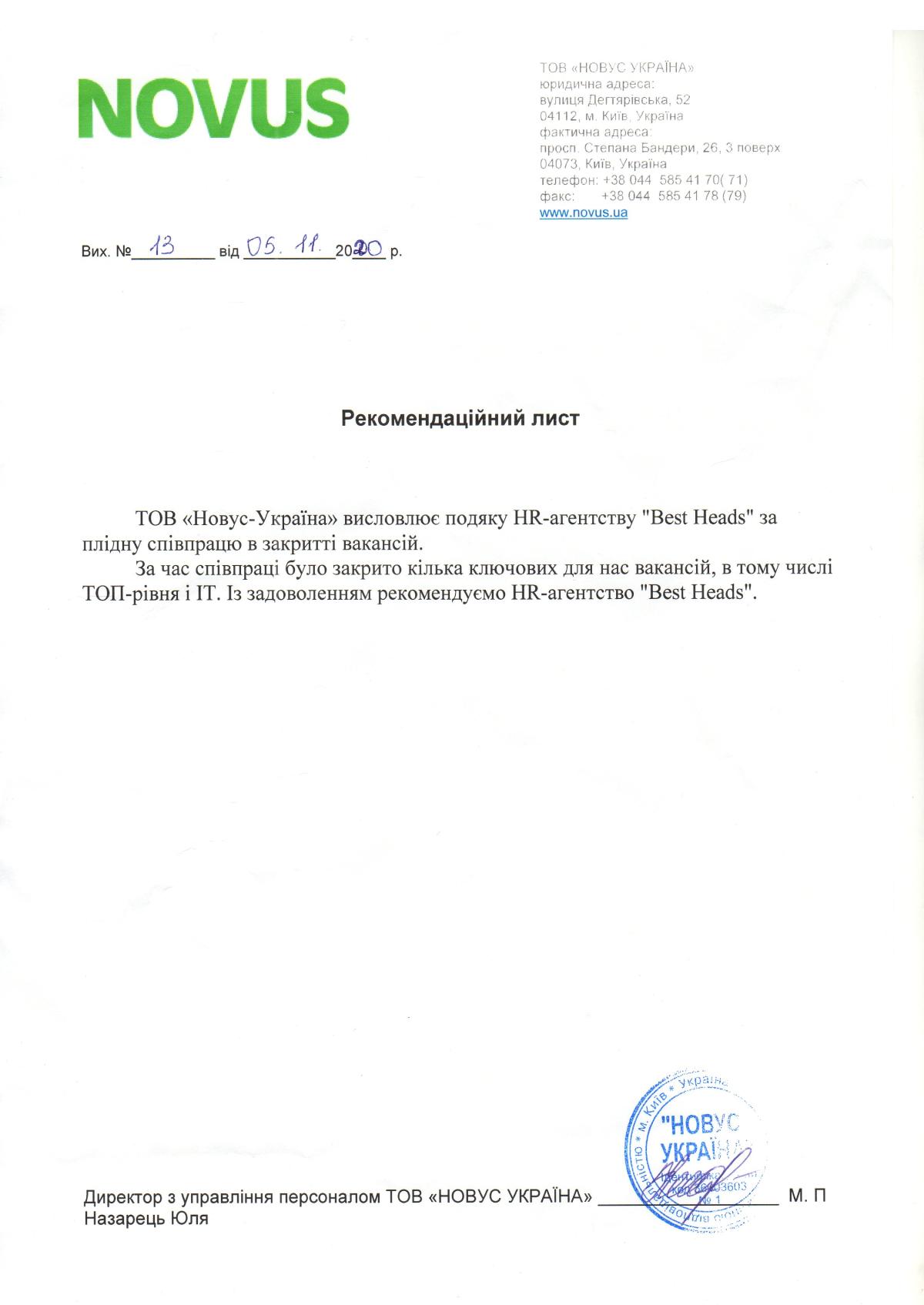
Novus-Ukraine LLC thanks Best Heads HR agency for our productive partnership in filling roles.
Over our time working together, we've closed several key positions, including top-level and IT roles. We're happy to recommend Best Heads HR agency.
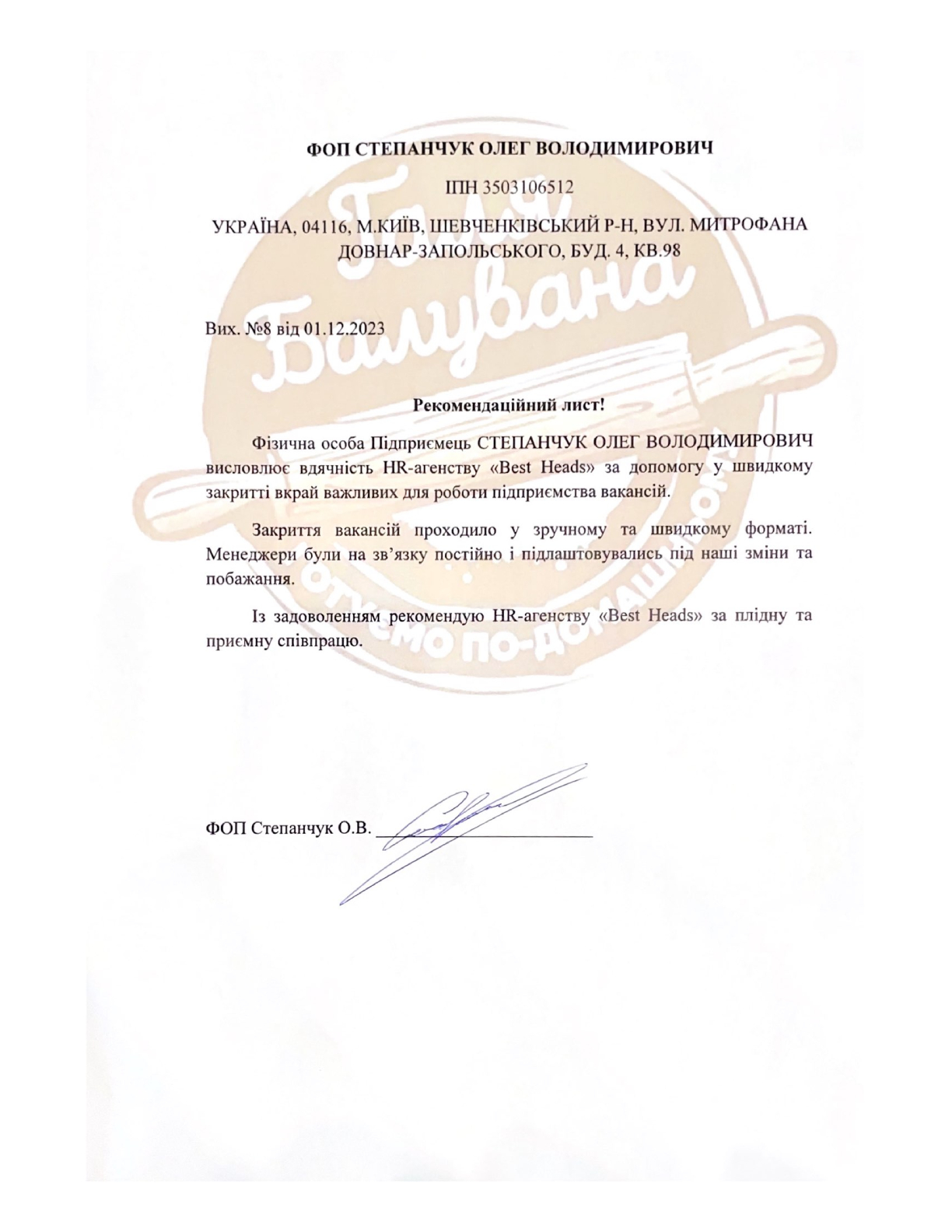
Sole proprietor Oleh Stepanchuk (Galya Baluvana brand) thanks Best Heads HR agency for helping us quickly fill roles that were critical to our operations.
The hiring process was smooth and fast. The team stayed in constant contact and adapted to our changes and feedback throughout.
We're happy to recommend Best Heads HR agency for a productive and enjoyable partnership.
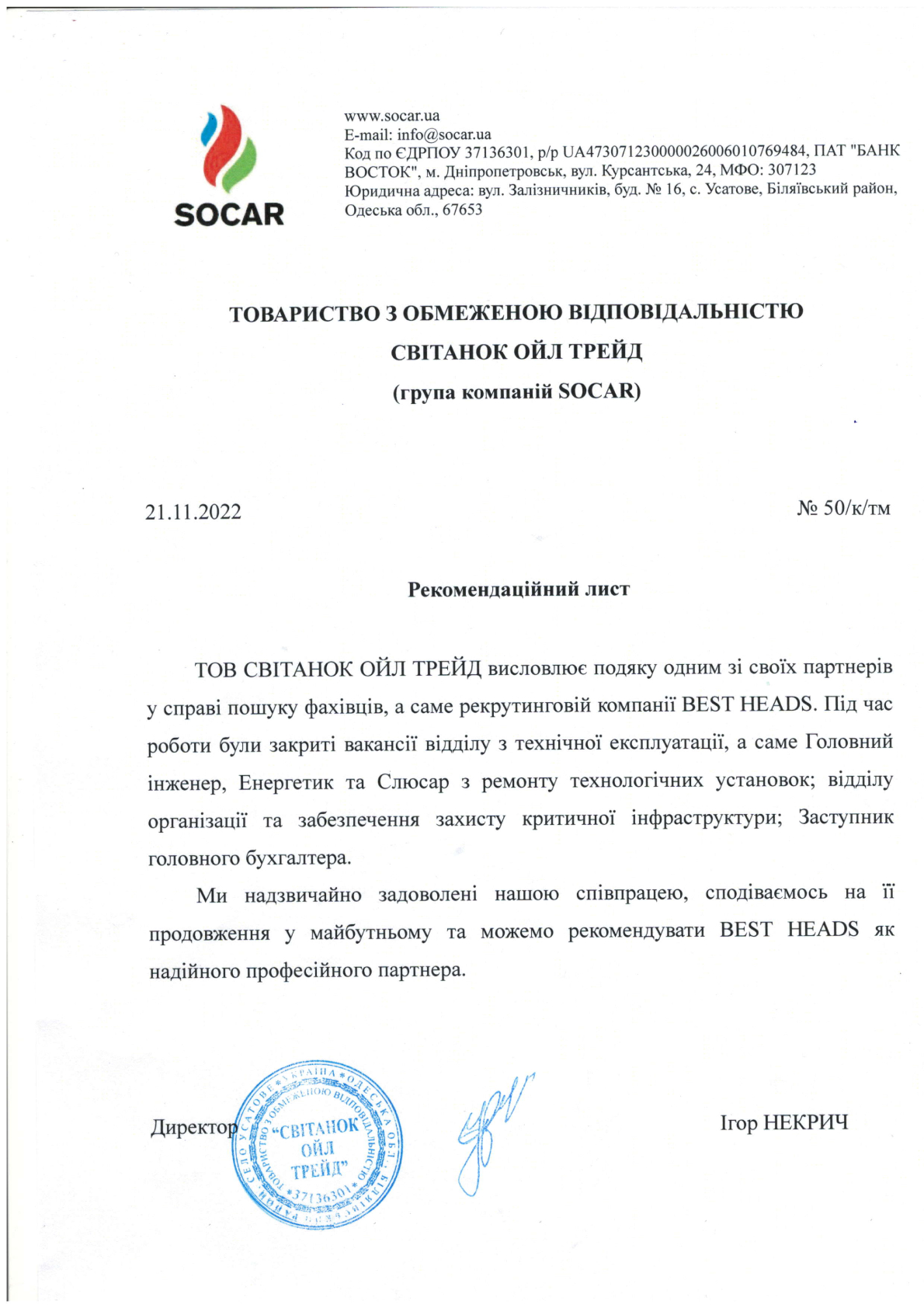
Svitanok Oil Trade LLC thanks one of our partners in talent acquisition — Best Heads recruitment agency. Over the course of our work together, they filled roles in our technical operations department — specifically Chief Engineer, Energy Engineer, and Industrial Equipment Repair Technician; in our critical infrastructure protection department; and Deputy Chief Accountant.
We're extremely happy with our partnership, look forward to continuing it, and can recommend Best Heads as a reliable and professional partner.
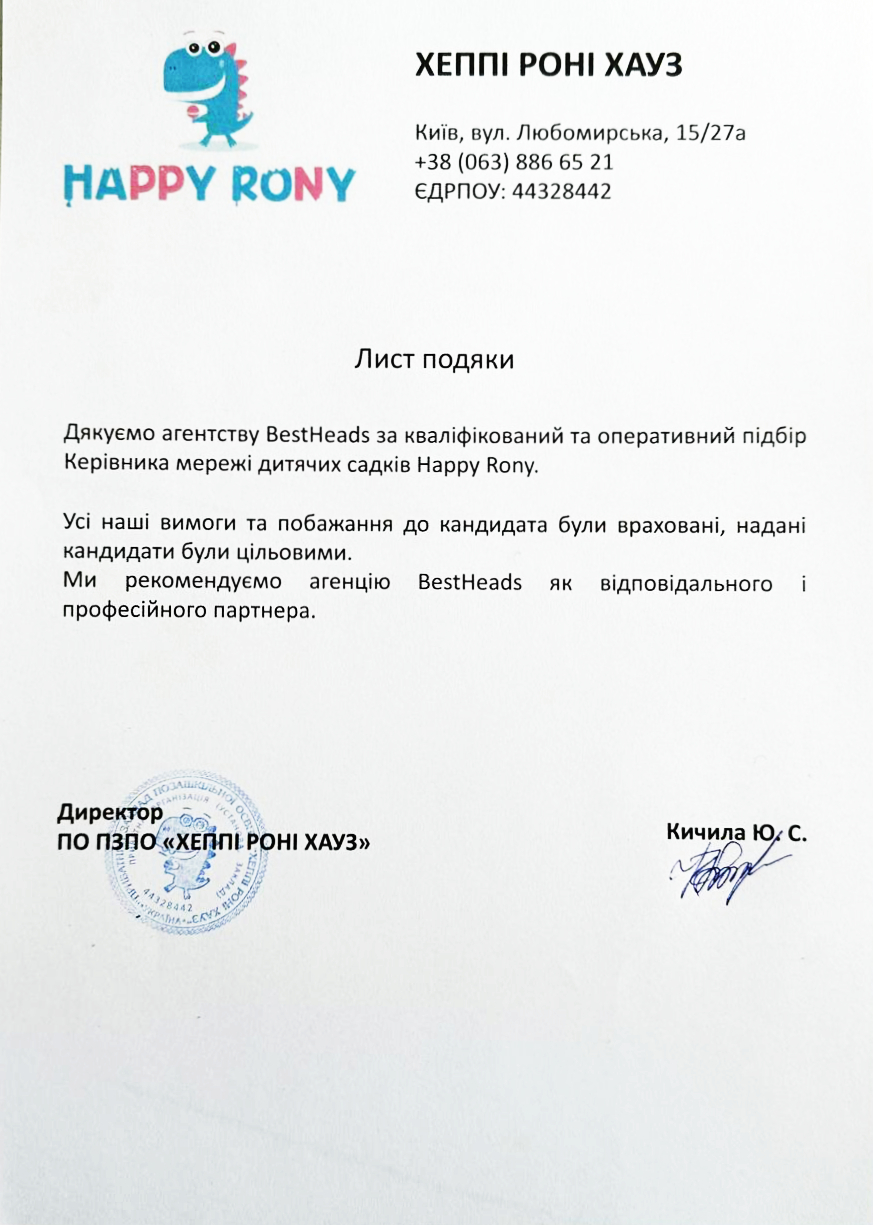
Thanks to BestHeads agency for the qualified and prompt placement of a Director for the Happy Rony chain of children's preschools.
All our requirements and preferences for the candidate were taken into account, and the candidates presented were a strong fit for the role.
We recommend BestHeads agency as a responsible and professional partner.
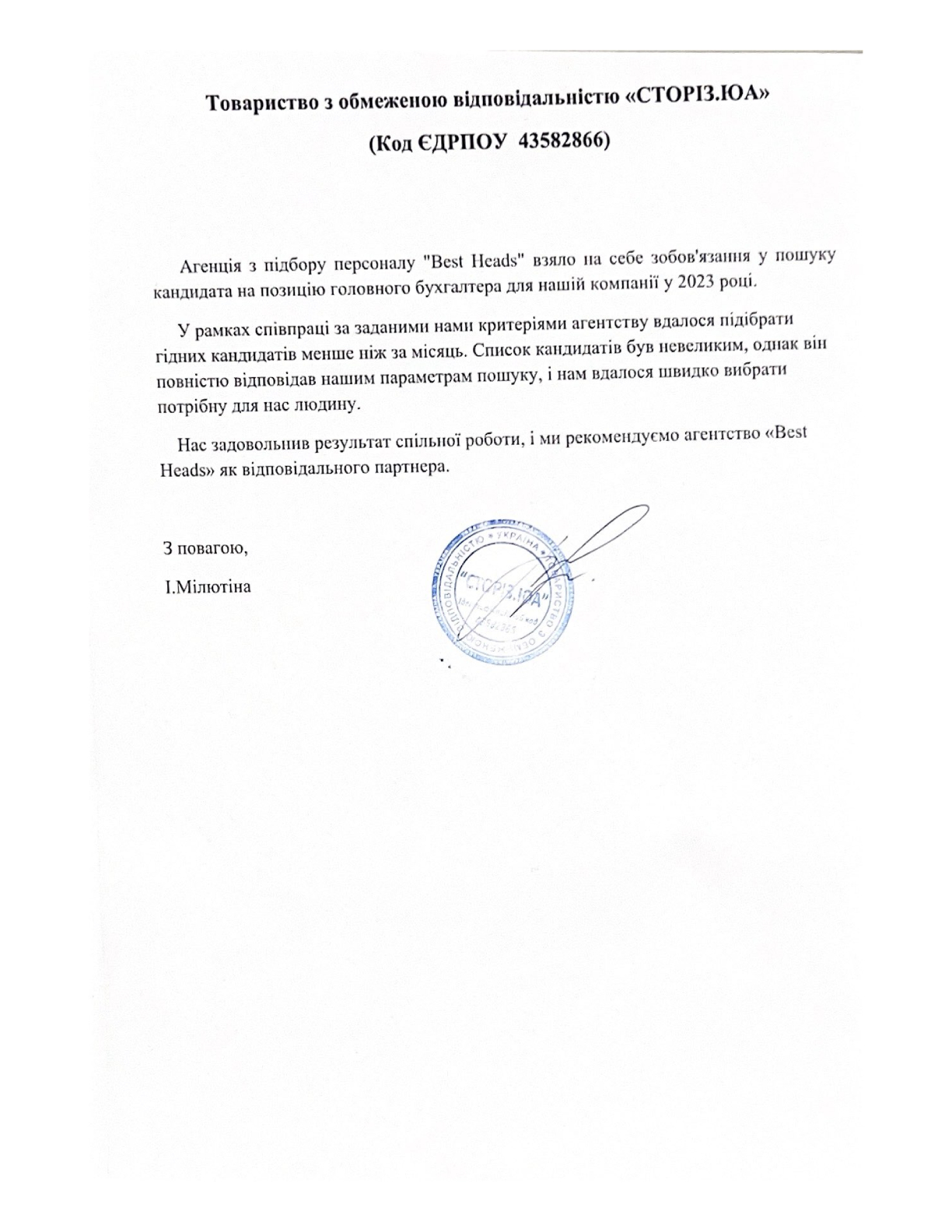
Best Heads recruitment agency took on the search for a Chief Accountant for our company in 2023.
Working from the criteria we set, the agency found strong candidates in under a month. The shortlist was compact, but it fully matched our search parameters, and we were able to quickly pick the right person for us.
We're happy with the outcome of our work together and recommend Best Heads agency as a reliable partner.
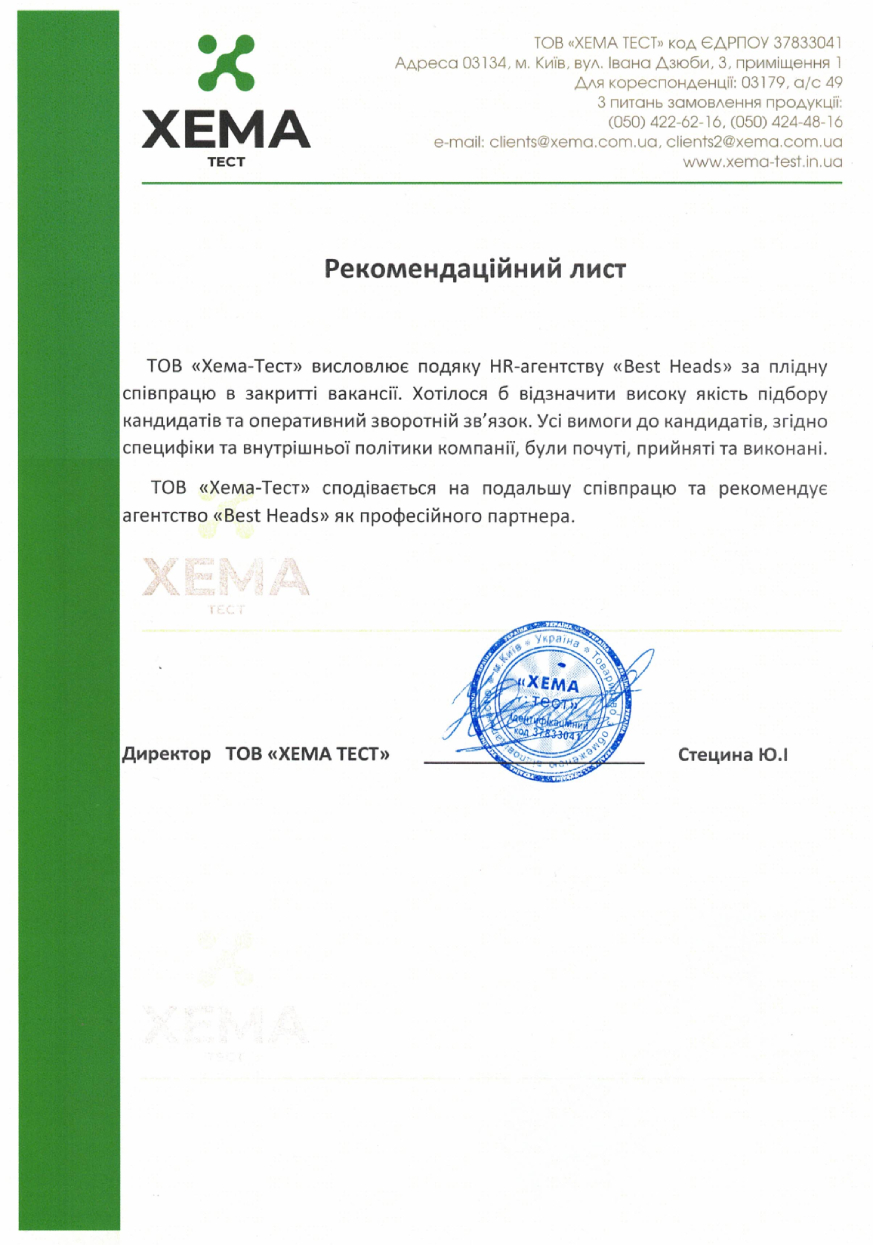
Khema-Test LLC thanks Best Heads HR agency for our productive partnership in filling roles. We'd like to call out the high quality of candidate sourcing and the responsive communication. All our requirements for candidates, including those specific to our company's policies and operations, were heard, understood, and delivered on.
Khema-Test LLC looks forward to continuing our partnership and recommends Best Heads as a professional partner.

To the team,
We want to sincerely thank your team for our productive partnership and the successful close of our top-priority role — Chief Accountant.
We deeply value your professionalism, your deep understanding of our needs, your responsiveness, and your clear communication at every stage of the search.
The candidate you presented has already started making a positive impact, and we're confident they'll contribute significantly to Monopack's growth.
Thank you for the quality of your work, your flexible approach, and your partnership. We look forward to continuing to work together!
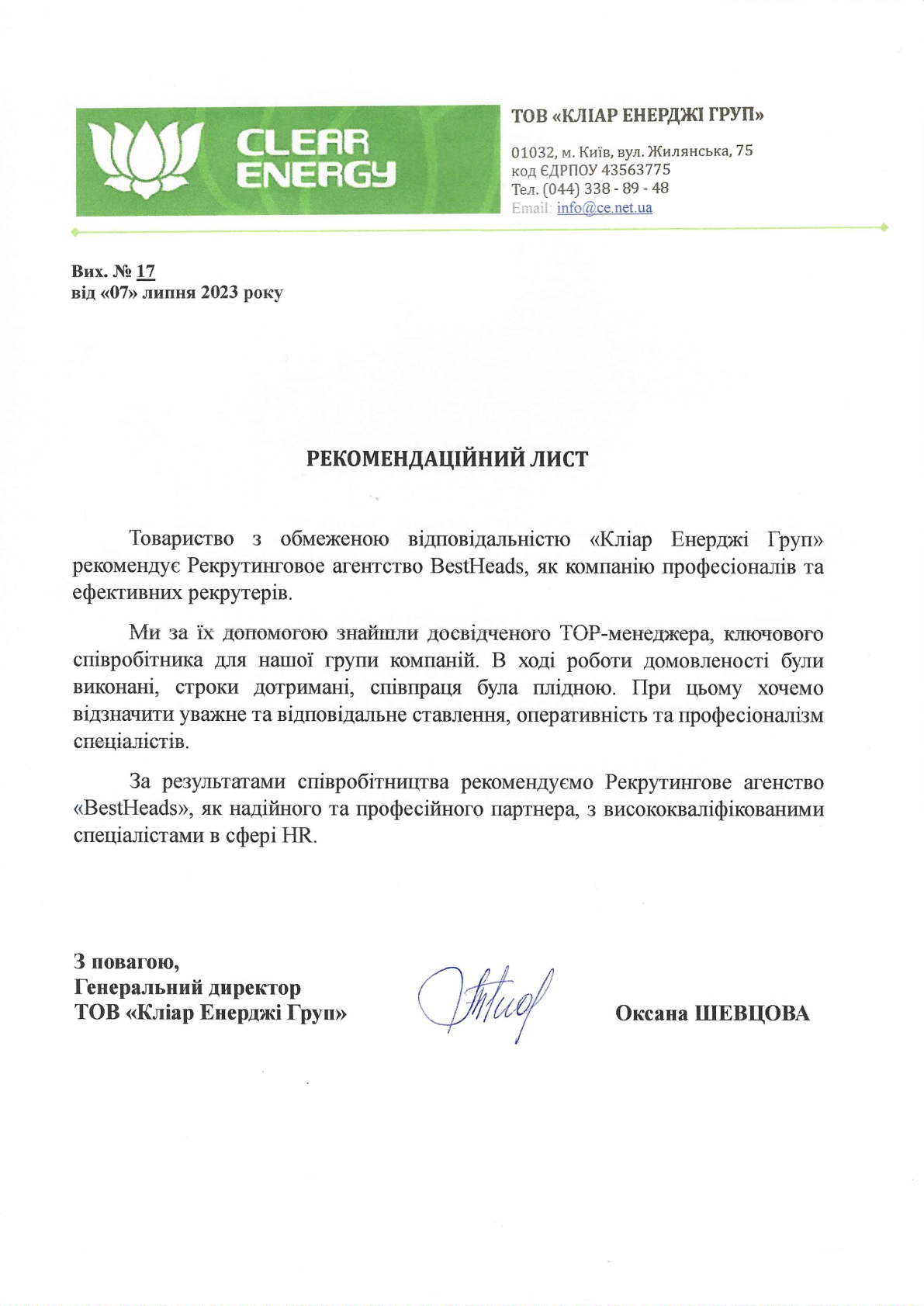
Clear Energy Group LLC recommends BestHeads recruitment agency as a team of professionals and effective recruiters.
With their help, we found an experienced top-level executive — a key hire for our group of companies. Throughout the process, commitments were met, deadlines were hit, and the partnership was productive. We'd also like to call out the attentive, responsible approach, the responsiveness, and the professionalism of their team.
Based on the outcome of our work together, we recommend BestHeads recruitment agency as a reliable and professional partner with highly qualified HR specialists.

On behalf of Solve.Care I would like to say thanks to "Best Heads" for such great cooperation. "Best Heads" helped us with two very critical positions: Technical Support Engineer and Senior Mobile (React Native) Developer. Both positions had very high demands and were on the market for more than 2 months. "Best Heads" provided us with a pool of qualified candidates and we successfully closed both positions within a month.
We have, and will continue to, recommend "Best Heads" to other companies as a very professional agency who can help you to close difficult vacancies with tough deadlines. Our team could not be more satisfied with your work, and we look forward to continuing this relationship.

On behalf of STEMAX, I want to thank Best Heads HR agency for our quality partnership on talent sourcing and placement.
The agency provided thorough consultation on the profile of the role we were hiring for, ran a salary market analysis for candidates, and shared it with us.
The candidates presented were a strong match for the role profile.
In 2018–2019, with our partners' help, we closed the CHRO and Head of Project Sales roles.
I recommend Best Heads HR agency as a reliable partner for talent sourcing and placement.
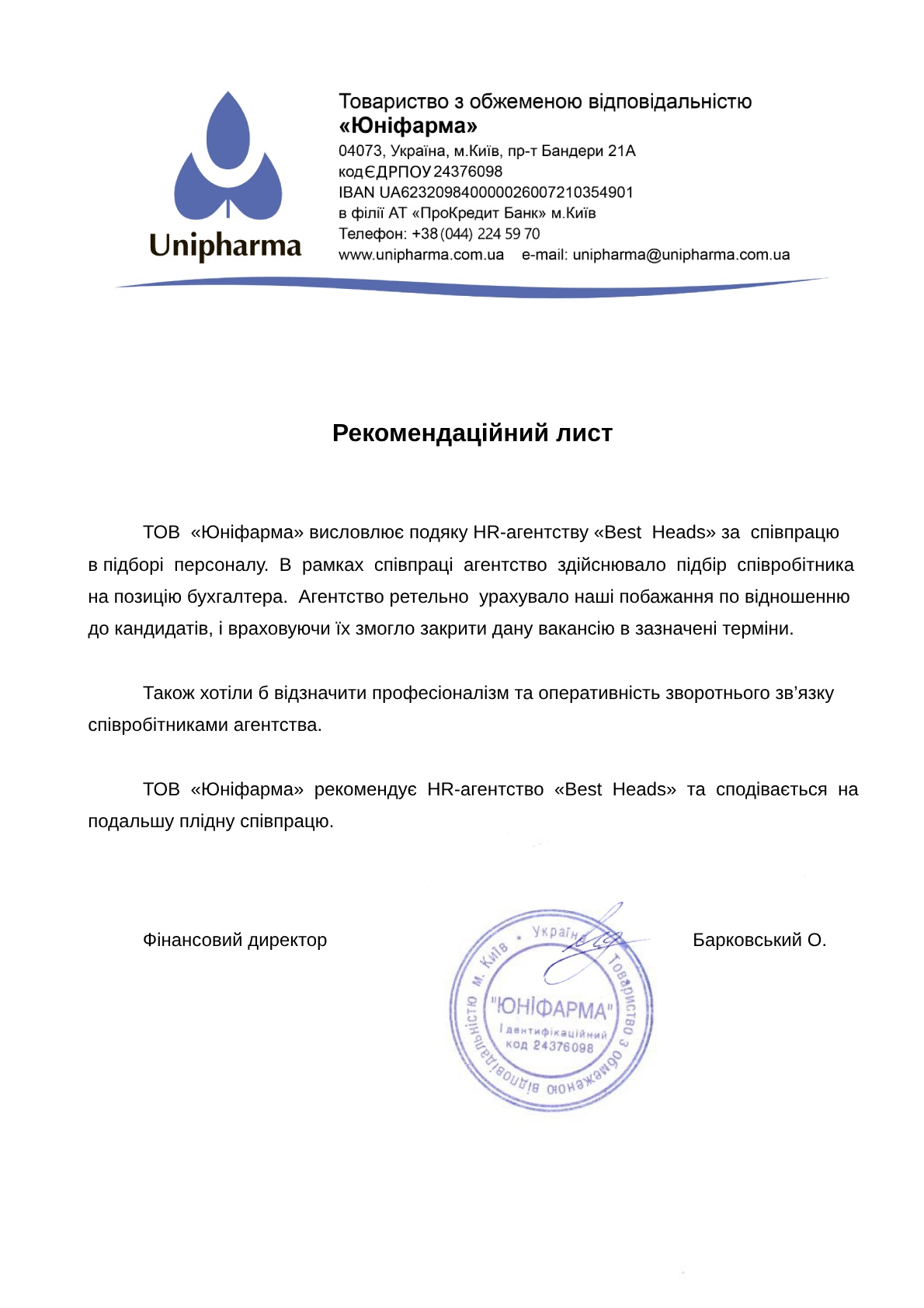
Unipharma LLC thanks Best Heads HR agency for our partnership on talent acquisition. As part of our work together, the agency ran a search for an Accountant role. The agency carefully accounted for all our preferences regarding candidates, and based on those, was able to close this role within the agreed timeline.
We'd also like to call out the professionalism and responsive communication from the agency's team.
Unipharma LLC recommends Best Heads HR agency and looks forward to continuing our productive partnership.
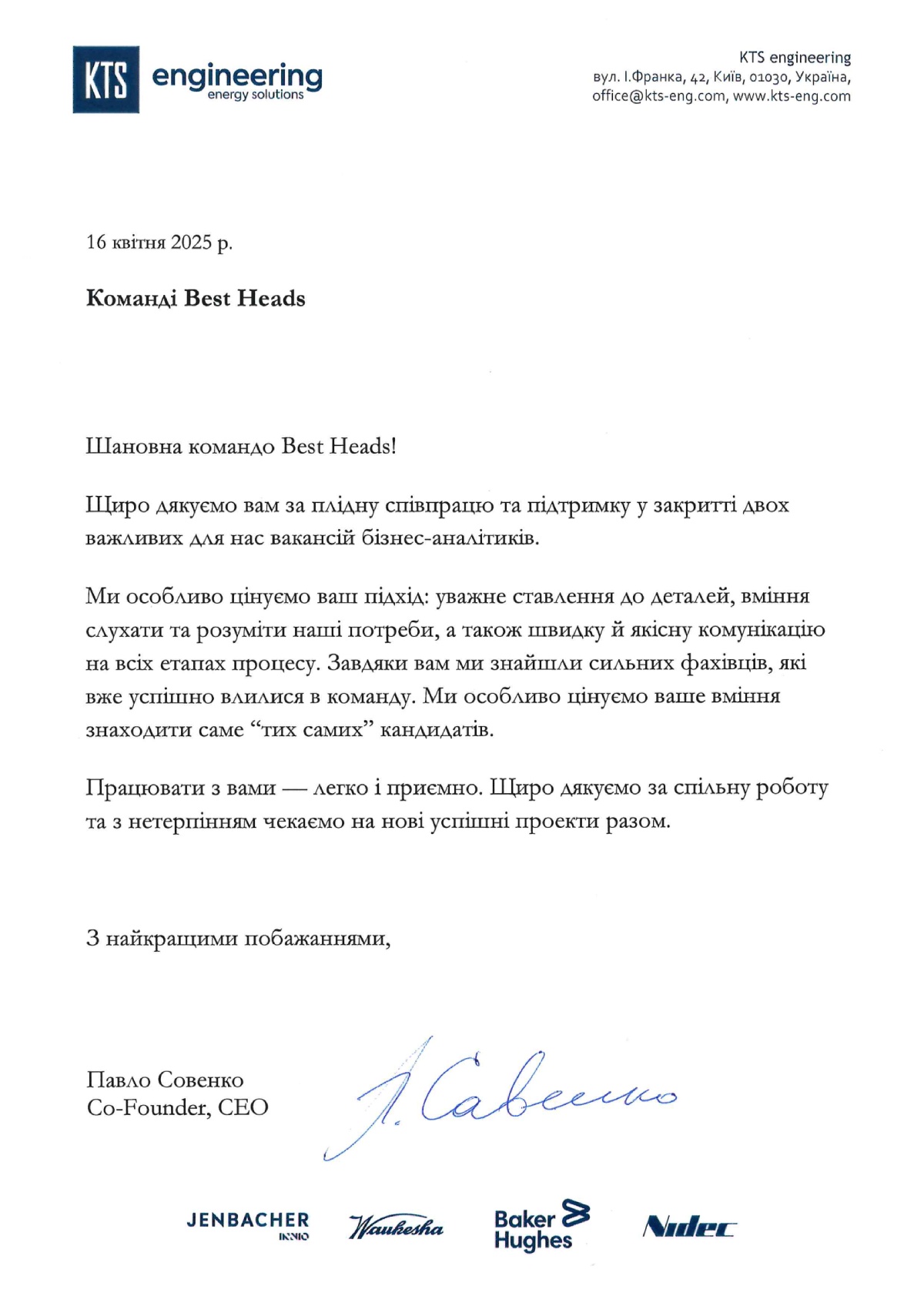
To the Best Heads team,
Thank you for our productive partnership and your support in closing two business analyst roles that were important for us.
We especially appreciate your approach: attention to detail, the ability to listen and understand what we need, and the fast, high-quality communication at every stage of the process. Thanks to you, we found strong specialists who have already successfully joined the team. We particularly appreciate your ability to find exactly the right candidates.
Working with you is easy and enjoyable. Thank you for working with us, and we look forward to more successful projects together.

On behalf of Imperia Holding LLC, we thank Best Heads HR agency for our partnership. They successfully closed what was a fairly challenging hire for our business — Head of Logistics. Over the course of the project, the agency ran a market analysis, presented us with 5 truly strong, quality candidates for the Head of Logistics role, and we picked the right fit.
We recommend Best Heads agency as a highly professional and reliable partner who will find the best candidates for executive roles, taking into account the specifics and requirements of your business.
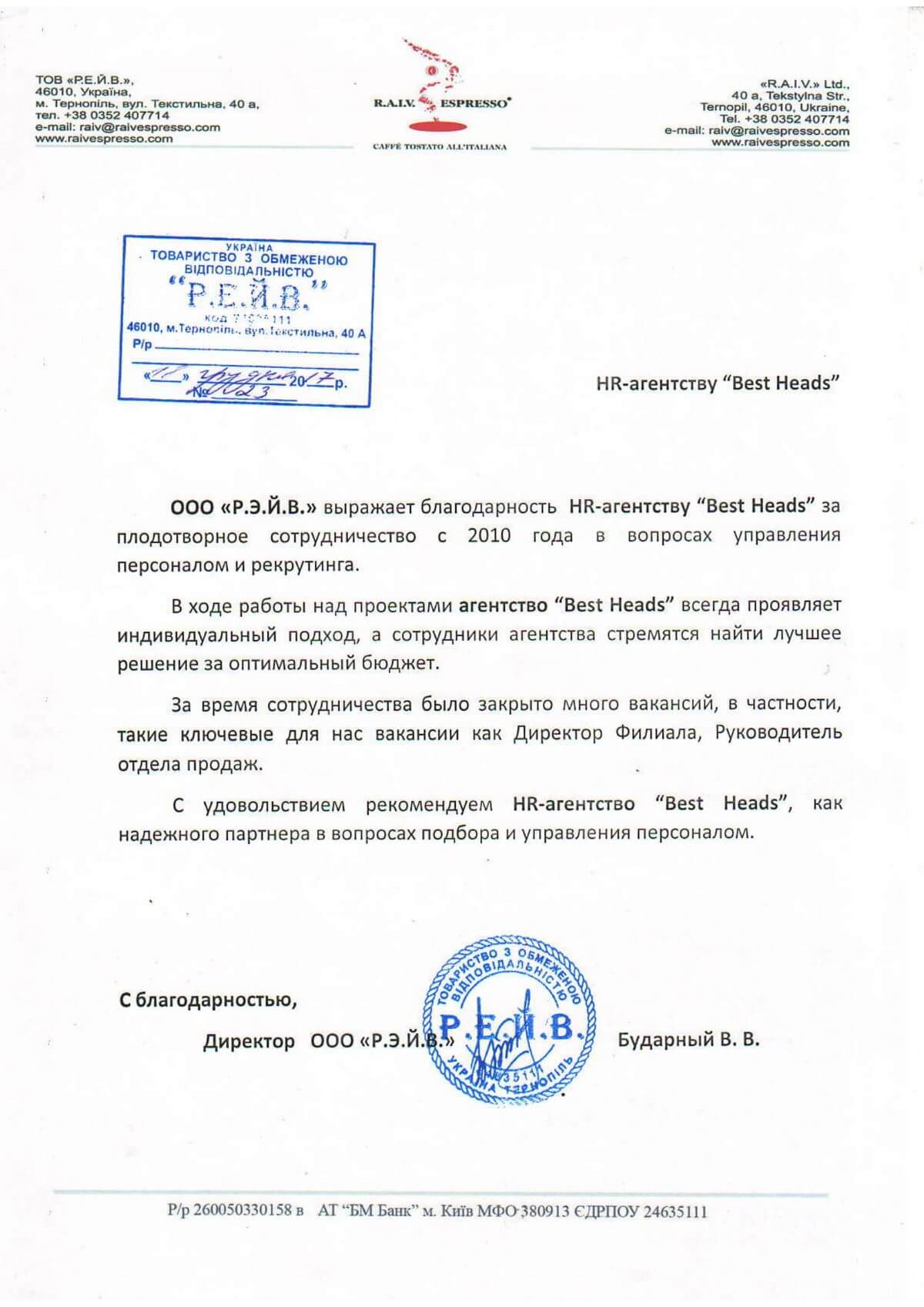
R.A.I.V. LLC thanks Best Heads HR agency for our productive partnership since 2010 on talent management and recruiting.
Throughout our work together, the Best Heads team has always taken an individualized approach, and their specialists work to find the best solution within the available budget.
Over time, we've closed many roles, including key positions like Branch Director and Head of Sales.
We're happy to recommend Best Heads HR agency as a reliable partner for talent acquisition and management.
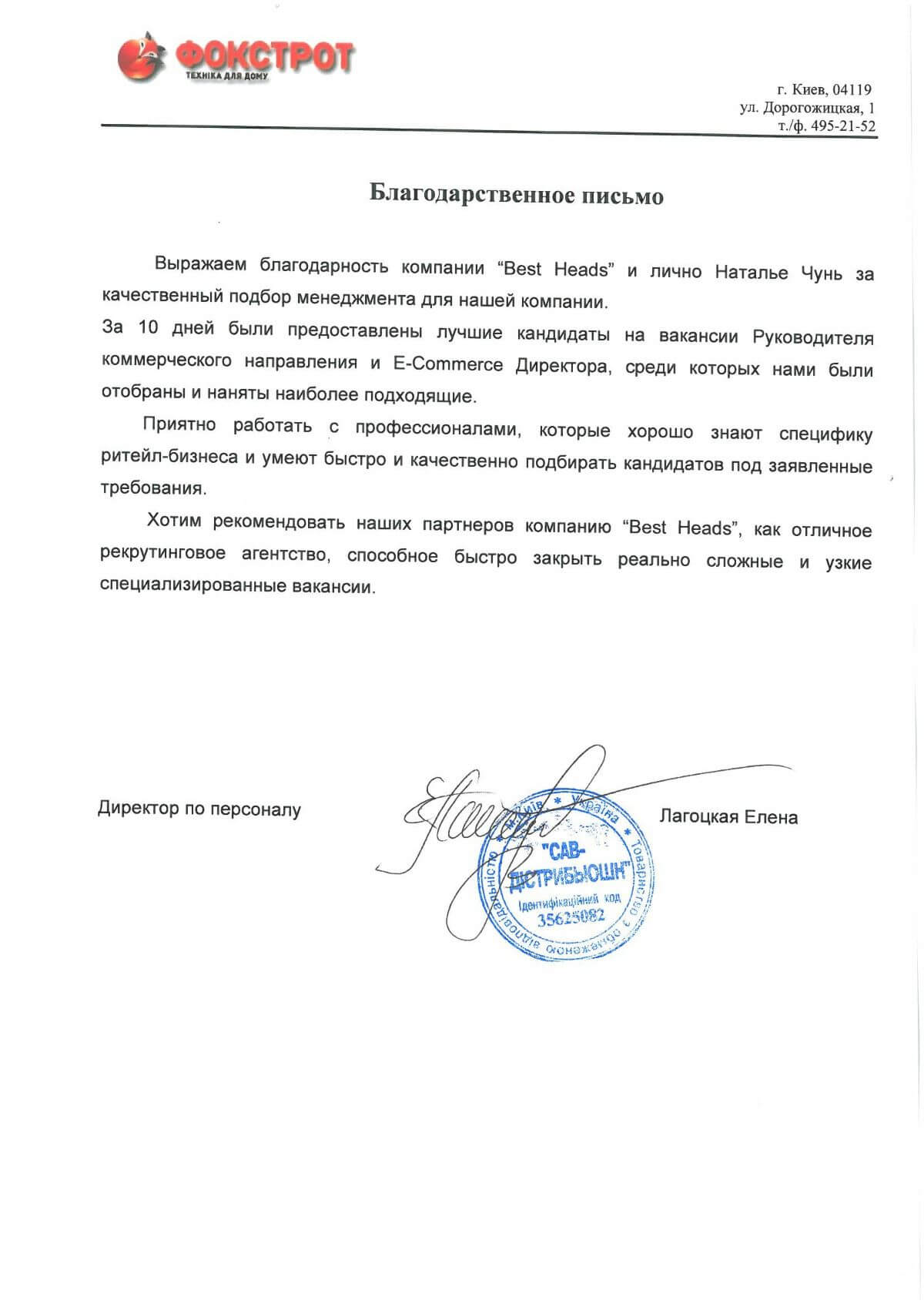
We thank Best Heads, and Natalia Chun personally, for the quality of the management-level recruiting for our company.
In 10 days, you presented the best candidates for the Head of Commercial and E-Commerce Director roles, and we picked and hired the strongest fits.
It's a pleasure to work with professionals who understand the specifics of the retail business and know how to source candidates quickly and accurately to the brief.
We're happy to recommend our partners at Best Heads as an excellent recruitment agency capable of quickly closing complex and highly specialized roles.
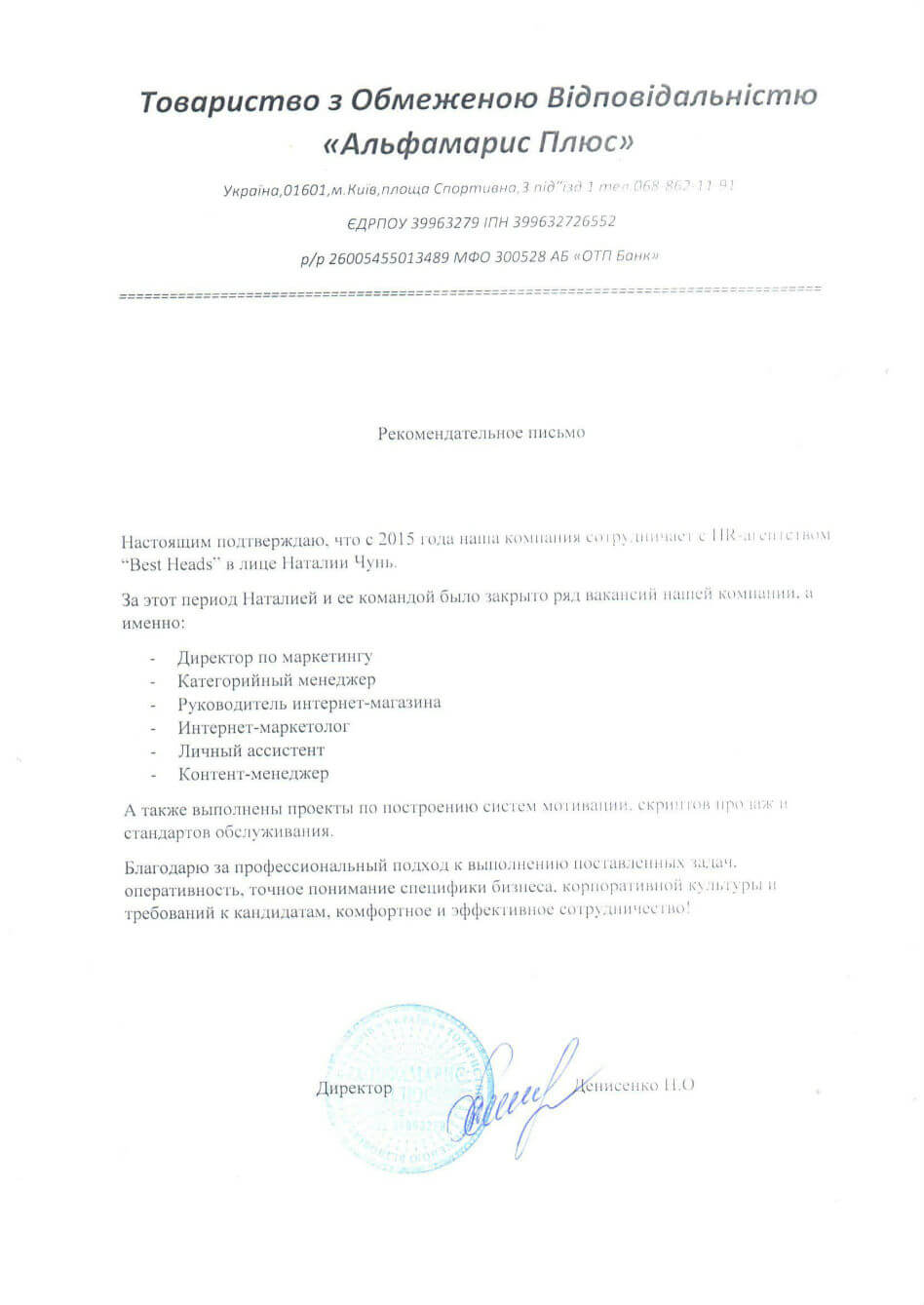
This confirms that our company has partnered with Best Heads HR agency since 2015.
Over this time, the agency has closed a number of roles for our company, including:
CMO
Category Manager
Head of E-commerce
Digital Marketing Manager
Executive Assistant
Content Manager
The agency also delivered projects on building incentive systems, sales scripts, and customer service standards.
Thank you for the professional approach, responsiveness, accurate understanding of business specifics, corporate culture, and candidate requirements, and for our smooth, effective partnership!
Industries we specialize in


About Us


Frequently Asked Questions
Pricing is set per engagement and depends on the role, timeline, NDA level, and any location or clearance requirements. The base model is a percentage of the candidate’s first-year compensation, higher for rare roles such as RF, EW, or Rust embedded. We quote an exact figure after a short brief. A 15-minute call is enough for a first estimate.
Yes, that is standard for defense and dual-use work. We sign before the brief, work from minimally disclosed information, and share product, stack, and location with a candidate only after they confirm interest and sign an NDA. We can work under your own NDA template, send it over.
We do not issue clearances; that sits with the employer and the authorized bodies. What we do is pre-screen for clearance eligibility, prior experience with restricted information, and the absence of disqualifiers, before anyone reaches your interview. Send your requirements and we will filter against them.
Yes. Many Ukrainian defense companies keep R&D in Ukraine and a commercial or fundraising office in the US, Poland, or Estonia. We staff both sides in parallel and have closed roles for companies in the US, Canada, Belgium, and Poland. Share your structure and we will scope the combined search.
For adjacent embedded roles, two to three weeks is realistic. Pure MilTech roles with an NDA and a location requirement run longer because the pool is narrow and sourcing is restricted: three to five weeks is a fair benchmark for senior embedded, and five to eight for rare RF or EW roles. Send the spec for an exact timeline.
Yes. We screen for relocation readiness at pre-screening and agree the relocation package with you before going to market. We have closed defense roles in exactly this format. Tell us the location constraint and we will filter for it from the first touch.
That is the most common reason defense clients reach out. Strong embedded and RF engineers rarely sit on public boards, and NDA roles cannot be posted openly, so the search has to run through closed channels. Tell us the role and where it stands now and we will map a realistic plan.
Both. Alongside embedded and software, we run hardware and RF engineer recruitment, antenna and DSP roles, and electronic warfare specialists. If your role sits at the hardware-software boundary, describe it and we will confirm coverage and a sourcing plan.
Every placement comes with a 90-day free replacement guarantee. If the engineer leaves or turns out not to be a fit inside that window, we re-run the search at no additional fee. We will walk you through the exact terms on a call.
The tightest pools today are RF and electronic warfare engineers, Rust and C/C++ embedded for UAVs, and computer vision engineers for GPS-denied navigation. Demand is shaped by Ukraine’s defense priorities around autonomous drones and machine vision. If you are hiring into one of these, the market is narrow, so start early and talk to us first.


